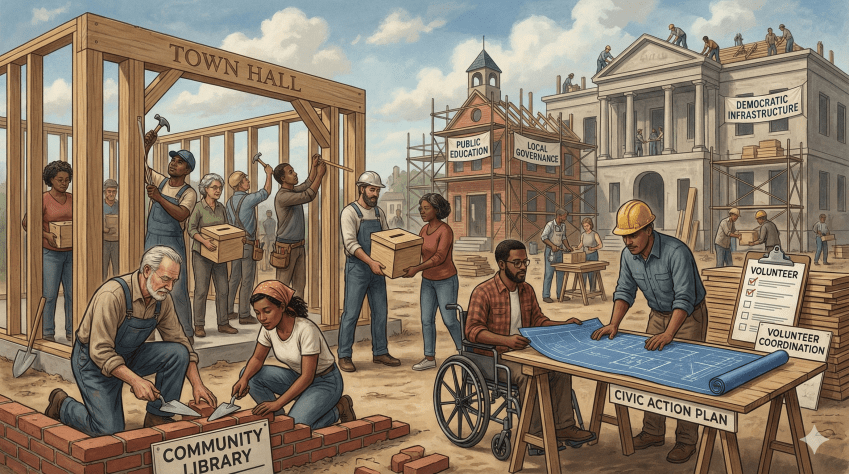
For Steve: A Lifelong Builder.
The Antidote
My previous essay, The Broken Infrastructure of Hope: How Americans Lost Faith in Self-Governance, and How to Rebuild It, diagnosed the problem: American civic infrastructure has broken down, and the hopelessness spreading across the country is a predictable consequence of that breakdown. The information systems that once gave citizens a shared basis in fact have fragmented. The governance systems that once translated citizen engagement into political change have been captured, hollowed out, or abandoned. The feedback loop between informed public opinion and responsive government has been severed. And the result is exactly what you’d expect: millions of Americans have disengaged, concluded the system is beyond repair, and retreated into criticism, apathy, or outrage.
That essay was about what went wrong and what repair would require. But the breakdown I described was not an accident. It was not the natural entropy of aging institutions. It was the result of what 50 Years of Economic Myths Have Delivered Americans Into Technofeudalism lays bare: a fifty-year campaign by concentrated wealth interests to systematically dismantle democratic power in this country. And this attack came in many forms, not just against public policy institutions like laws and government, but against our knowledge systems themselves.
I want to be precise about what I mean by “campaign,” because getting this wrong leads to the wrong response. This is not a conspiracy. There was no secret room where billionaires drew up a master plan to dismantle American democracy on a whiteboard. That is not how oligarchy works. It has never been how oligarchy works. What happened, and what is still happening, is a confluence of aligned interests. Corporate executives, wealthy donors, ideological think tanks, captured academics, our political duopoly, and compliant politicians all pursued similar goals for similar reasons, independently and in loose coordination, because those goals served their interests. They didn’t need a secret plan. They needed the same incentives, and they had them.
This distinction matters because it changes what you’re fighting. A conspiracy can be exposed and dismantled. You find the plot, you reveal it, you prosecute the plotters. Aligned interests are harder. There is no single plot to expose. There are thousands of independent actors making rational decisions within a system that rewards the concentration of power. A billionaire funds an economics department that produces research favorable to deregulation. A politician accepts that research as credible because it comes from a prestigious university. A media outlet reports the research uncritically because it fits the conventional wisdom. A voter absorbs it as settled fact. No one in that chain is conspiring with anyone else. Each is simply operating within the incentive structure in front of them. And the result is indistinguishable from coordinated action.
This is the historical mechanism through which oligarchy has always embedded itself: not through coups or conspiracies, but through the slow alignment of institutional incentives toward concentrated power. The Roman Republic did not fall because senators hatched a secret plan. It fell because wealthy landowners, military commanders, and political elites all found it individually advantageous to hollow out republican institutions, and no one with power had sufficient incentive to stop them. The Gilded Age in America was not a conspiracy by Rockefeller and Carnegie. It was a system where every actor with capital found it profitable to capture regulation, suppress wages, and consolidate industries, and the political system rewarded them for doing so. The pattern repeats because it does not require coordination. It only requires a system where concentrated wealth can convert economic power into political power, and where no countervailing force exists to prevent it.
That is what we are living through now. And if you are looking for a villain to unmask, you will miss it. The threat is structural, not personal.
But here is what I believe, and it is why I write. What confronts us now is a question: can the people take this system back? Can we guide it toward what it was supposed to be, a country where the middle class grows and prospers, where people live good and safe and secure lives, where sometimes people who don’t like each other very much agree to live together and make a country anyway? I believe we can. I believe it is possible. I believe the America I grew up in, the one that welcomed my family, the one where pluralism was a strength and not a threat, can be restored and expanded. More freedom, not less. More room for difference, not less. A country where economic security replaces fragility, and where citizens are strong enough to govern themselves without fear. That is not nostalgia. It is a destination. And the reason I write is because I believe it is still within reach, that taking it back is not just possible but is the unfinished work this country was built for.
Which means the response has to be structural.
An entire branch of knowledge that should be grounded in the scientific method was coopted and steered away from empirical rigor. I made this case in Economics is not a Science. Mainstream economics abandoned falsifiability, started resolving disputes through institutional power rather than evidence, and shaped its conclusions to serve corporate funding sources. This wasn’t incidental. It was strategic. When you control what counts as “sound economics,” you control what policies the public believes are possible.
And the attack didn’t stop with academic knowledge systems. It went after the information supply chain itself. For most of the twentieth century, Americans had something that is easy to take for granted until it is gone: a physical information supply chain with built-in verification and accountability. Universities conducted peer-reviewed research. Newsrooms employed editors, fact-checkers, and reporters who could be sued for libel. Publishers had reputations that took decades to build and could be destroyed by a single fabrication. These institutions were not perfect. They had blind spots, biases, and failures. But they operated within a system where claims could be traced to sources, sources could be evaluated, and institutions paid real consequences for getting things wrong. That system produced something close to ground truth: not perfect truth, but a shared factual basis that citizens could use to reason about public life. Then came what I called The Parasite’s Dilemma: How AI Destroys the Quality Information Supply Chain It Depends On: the rise of big tech, big data, and AI systematically destroyed that supply chain. Digital platforms obfuscated provenance and lineage, making it nearly impossible to trace where information comes from or evaluate its credibility. AI-generated content flooded the information environment with synthesized material disconnected from any verifiable source. The old system said: here is a claim, here is where it comes from, here is who stands behind it. The new system says: here is content. No origin. No accountability. No way to know what you’re looking at or who benefits from you believing it. The result is not just misinformation. It is the complete collapse of the framework citizens once used to distinguish truth from manipulation. That is not an accident. It is the third front of the same war.
For five decades, oligarchs and corporate interests used captured economics, funded think tanks, the language of “fiscal responsibility,” and now algorithmic control of information itself to condition Americans across party lines to accept artificial limits on our collective power. They hollowed out public institutions and made the destruction of the middle class sound like prudent governance. What began as corporate capture in the Reagan era evolved through financial sector dominance to today’s tech and finance oligarchy. The result is what some call technofeudalism: a system where a shrinking number of technology-enabled elites control the platforms, the data, the labor markets, and increasingly the governance structures, while the rest of us become tenants on their digital estates. The hopelessness I described in the previous essay is not a bug. It is a feature of a system designed to make democratic participation feel pointless.
This essay is about the antidote: being a builder. Not as a nice idea, not as a motivational slogan, but as the only response that has ever actually worked when systems fail and people lose hope.
Here is the core of it. Broken systems do not fix themselves. They do not gradually self-correct through the passage of time or the goodwill of the powerful. And nobody else is coming to fix them for us. This is the argument at the heart of Defending Democratic Capitalism Through Capacity Stewardship: the work of preserving democratic capitalism falls to citizens, not leaders, not institutions operating on autopilot. No candidate, no court ruling, no viral moment is going to reverse the trajectory we are on. The consolidation of economic and political power into fewer and fewer hands is not a future risk. It is happening now. The institutions that once distributed power across millions of citizens are being hollowed out in real time. If we do not rebuild them, someone else will fill that vacuum, and they will not fill it with democracy. They will fill it with control.
The only thing that has ever reversed that kind of trajectory is people who decided to build. Not people who criticized, though criticism has its place. Not people who were outraged, though outrage can be a starting point. People who built. Who created institutions, organizations, coalitions, and systems where none existed before. Who did the unglamorous, long-timeline, often unrewarded work of constructing the infrastructure that makes self-governance possible.
That is the antidote. And to understand why it is the only antidote, it helps to be honest about what the alternatives actually are.
Criticizing is easy. I don’t say that to be dismissive. I say it because it’s true, and because recognizing it matters if the antidote is going to take hold. Criticism requires no risk. You identify what’s wrong, and you’re done. You never have to commit to a fix. You never have to propose something that might not work. You never have to put your name on an effort that could fail publicly. The critic occupies the safest position in any room: the person who evaluates what others have built without ever having to build anything themselves.
Apathy is even easier. It requires nothing at all. You check out. You stop reading the news. You stop going to meetings. You tell yourself the system is broken and your participation won’t change that, and then you go on with your life. Apathy doesn’t even ask you to form an opinion. In a country where the systems that once rewarded engagement have stopped working, apathy is the rational default. That is what makes it so dangerous.
And then there is outrage, which is the trickiest of the three because it feels active. Outrage feels like engagement. You’re angry. You’re sharing posts. You’re arguing with strangers. You’re performing all the motions of someone who cares deeply. But outrage, most of the time, is a reaction, not an initiative. It consumes energy without directing it anywhere. Social media has made outrage feel like participation while functionally substituting for it. You can spend four hours a day furious about the state of the country and never once do anything that changes it.
I am not trying to shame anyone. I have done all three of these things. I have criticized from the sidelines. I have checked out when it felt hopeless. I have been outraged on the internet in ways that changed absolutely nothing. None of those things rebuilt a single piece of the broken infrastructure I described in the previous essay. None of them will.
Building is what rebuilds. And building asks something of you. Your time. Your energy. Your willingness to fail. Your comfort with being wrong. Your patience with progress so slow you may not see the results in your own lifetime. But before it asks for any of that, building asks for something deeper: a shift in how you think. Being a builder is not just action, deed, or word. It is a mentality. It is the shift from “someone should fix this” to “I will build what is needed to fix this.” It is the move from passive consumer of political content to active producer of political infrastructure. It is the foundational decision that when you see something broken, your first instinct is not to criticize, not to despair, but to ask: what can I build to fix this?
That mentality, once adopted and sustained, turns into action. But the action without the mentality is just performance. And the mentality requires something else that most calls to action leave out: understanding. You cannot build effectively if you are operating from a false map. The economic orthodoxies that most people accept as settled science are not science at all (Economics is not a Science). The monetary myths that constrain our political imagination do not align with how our system actually works (Why Monetary Systems Matter). And the information environment that should give citizens a shared basis for reasoning is being systematically destroyed by the very platforms that promised to democratize knowledge, the dynamic I explored in The Parasite’s Dilemma: How AI Destroys the Quality Information Supply Chain It Depends On. A builder who does not understand these realities will build on sand. The mentality is what makes building the hardest posture to sustain, and it is the only one that produces lasting change.
This essay asks the harder question that follows from the diagnosis. What does it actually take to be the person who does the repair work? Not what policies should change. What disposition is required? What kind of person looks at broken systems and decides, against all the incentives pulling them toward criticism or apathy or outrage, to build?
What the Antidote Looks Like
I want to be careful here, because “be a builder” can sound like something you’d find on a motivational poster next to a stock photo of a sunrise. That is not what I mean.
The builder ethic in America is not about entrepreneurship in the commercial sense, though it includes that. It is about people who looked at something that didn’t exist, something the country needed, and made it exist. Not by asking permission. Not by waiting for conditions to improve. By building into resistance, into uncertainty, into systems that were never designed to support them.
But I want to be precise about what kind of building I’m talking about, because two words matter here: accumulation and extraction. Accumulation is when wealth and power concentrate into fewer and fewer hands. Extraction is how it happens: the process of pulling value out of communities, workers, and public systems and funneling it upward. (Even the tax code is designed to facilitate this upward transfer, something I documented in How Corporate-Friendly Accounting Rules Create a $30 Trillion Transfer from Consumers into Wealthy Pockets.) These are not building. They are the opposite of building. They hollow out the structures that make shared prosperity and self-governance possible. The kind of building I’m talking about is the kind that strengthens democratic infrastructure. The kind that distributes power rather than concentrating it. The kind that makes self-governance possible for more people, not fewer.
And here is the test that separates genuine building from accumulation dressed up as innovation: good systems have outcome measures, transparency, accountability, and disclosure built into them as institutional practices. Can you measure whether the system is actually working for the people it claims to serve? Can citizens see how decisions are made and money is spent? Can poor performance be identified and addressed? Are conflicts of interest and outside influences visible to the public? When systems have these features, they serve citizens. When they don’t, they serve whoever controls them. That distinction matters because there is another kind of building happening right now, and it fails every one of those tests.
The consolidation of control over markets, data, labor, and governance itself into the hands of a shrinking number of people and corporations. When a handful of tech platforms control the information environment, when a few corporations own the infrastructure of daily life, when billionaires can purchase political outcomes, what you have is not building. It is accumulation through extraction. It is the construction of a new feudalism with digital tools. And it operates precisely by eliminating outcome measures, transparency, accountability, and disclosure. Algorithms are opaque. Corporate lobbying is hidden. Outcomes are measured in shareholder returns, not citizen wellbeing. The machinery of extraction depends on nobody being able to see clearly how it works.
This concentration is enabled by something most Americans do not see. The title of my earlier essay says it plainly: 50 Years of Economic Myths Have Delivered Americans Into Technofeudalism. Five decades of economic mythology have conditioned all of us, across party lines, to accept artificial limits on our collective power. Republicans invoke “fiscal responsibility” to block social programs. Democrats accept budget constraints as real and argue only about percentages. Both use the same language to make destructive policies sound responsible. The myths create a devastating trap: economic insecurity makes people politically exploitable. When you are fragile, you cannot afford to resist bad deals. You accept worse conditions. You become more economically fragile. And you spiral downward toward what amounts to modern serfdom. Meanwhile, economic security creates the opposite: the foundation to take risks, reject exploitation, and spiral toward genuine self-determination. The policies that could create that security have been blocked for decades by myths that both parties promote as responsible governance.
The builder ethic I’m talking about is the one that fights that. It creates the countervailing institutions, the distributed power, the civic architecture that keeps a republic functioning as a republic. And it does so with clear eyes about the forces arrayed against it. The builders I’m describing don’t just build structures. They build structures with outcome measures, with transparency, with accountability, with disclosure. They build systems that citizens can see into, evaluate, and hold to account. That is what distinguishes democratic building from the accumulation and extraction it opposes.
Consider the labor organizers of the late 1800s and early 1900s. They didn’t just protest working conditions. They built. Unions. Mutual aid societies. Worker cooperatives. They created the institutional infrastructure that made collective bargaining possible. Before they built those institutions, workers had grievances. After they built them, workers had power. The difference was not attitude. It was architecture.
Consider the NAACP’s legal strategy that culminated in Brown v. Board of Education in 1954. That ruling didn’t arrive because someone gave a speech that moved the nation to tears. It arrived because lawyers spent decades, case by case, building a legal architecture that made the dismantling of segregation logically and constitutionally inevitable. It was patient, unglamorous, institutional work. Most of it happened in courtrooms and law offices, not on the evening news. The people who did that work were builders. They constructed something where nothing had existed before, and what they constructed changed the country.
Consider Horace Mann and the founders of public education. They didn’t just argue that schooling mattered. They built state education systems from nothing. They created curricula. They trained teachers. They established funding mechanisms. They saw a country that needed an educated citizenry and they built the infrastructure to produce one. That is the builder ethic in its purest form: seeing what’s needed and then doing the unglamorous work of making it real.
Consider the community organizers across every era who built the local infrastructure of civic life. Libraries. Settlement houses. Voter registration drives. Neighborhood associations. These are not famous people. Most of their names are lost. But they are the builders who made democracy function at the ground level, in the places where people actually live.
And consider something I know from personal experience: immigrant communities. My parents came to this country and they built. Businesses. Cultural institutions. Mutual aid networks. Connections within and across communities. I grew up in a time and a place and an America where my parents and I were always welcome, where our diversity was embraced, where we were allowed to be part of the community and build it. That matters. That welcoming context made building possible. This is what immigrants have done in every generation, in every wave of arrival, when given the chance. They built into the fabric of this country, and in doing so they expanded what the country was. The builder ethic is not an abstraction to me. I grew up watching it, and I grew up in a country that let my family do it.
The thread connecting all of these is simple but demanding. None of these people waited for permission. None of them waited for conditions to be favorable. None of them waited for the broken systems around them to repair themselves first. They built into resistance. They built into systems that were not designed to support what they were building. And what they built outlasted them. What they built was democracy itself, not as an ideal but as a functioning set of institutions that distributed power and created accountability. Every one of those examples was an act of democratic construction. Every one of them made self-governance more real for more people. Every one of them was the antidote to the breakdown of their era.
Why Building Is Hard, and Why People Avoid It
If building were easy, everyone would do it. It is not easy. And this essay loses all credibility if it pretends otherwise.
The risk of failure is real. Critics cannot fail. They are responding to what already exists, and if their criticism lands, they look smart. If it doesn’t, they move on to the next thing. Builders are exposed. The person who starts a civic organization, runs for local office, or launches a community initiative has put their name on something that might not work. Failure for a builder is public and personal. It is not a bad take that gets forgotten in two days. It is months or years of effort that everyone can see didn’t produce what you hoped. That exposure is why many capable people choose the safety of criticism instead.
The timelines are brutal. Building produces results on a scale of years and decades, not days. We live in an information environment optimized for immediate reaction. Every platform, every algorithm, every notification is designed to reward the instantaneous. Sustained effort toward distant goals feels unrewarded in that environment because it is unrewarded, at least by the metrics we’ve been trained to care about. The feedback loops that once told people their work was accumulating toward something have been compressed or severed entirely. You can spend three years building a voter education nonprofit and get less visible recognition than someone who tweets something clever about last night’s news.
The loneliness is real. The critic has an audience. The outraged person has a community of the equally outraged. The builder, especially in early stages, often works in relative isolation. There is no viral moment for the person quietly serving on a planning commission, or spending weekends knocking on doors for a school board candidate, or running an after-school civic education program that reaches forty kids at a time. Building is often invisible work, and invisible work is lonely work.
The temptation to retreat is constant. This is the one I want to spend extra time on, because it is the most dangerous. When building feels impossible at scale, the natural instinct is to shrink your ambitions. To focus only on what you can control. To retreat into the local and the personal and tell yourself that’s enough. This is precisely the pattern behind Why Progressives Are Accidentally Helping Authoritarians Win: progressives, frustrated by corporate capture of federal politics, have increasingly abandoned the work of building strong national systems in favor of local-only solutions. Community gardens. Neighborhood cooperatives. Personal lifestyle changes. These are valuable, but when they become substitutes for engaging with the systems that actually allocate power and resources at scale, they become a form of retreat dressed up as action.
This retreat is often driven by a specific misunderstanding: the belief that we cannot afford to build at scale. The persistent myth that ambitious national programs will “blow up the debt” or that transformative investment requires “finding the money” through higher taxes. These are hard money misconceptions left over from the gold standard era, the kind I traced in Why Monetary Systems Matter, and they constrain what builders believe is possible. In our actual monetary system, the constraint is not money. It is productive capacity: workers, materials, infrastructure, organizational capability. When builders accept false fiscal constraints as real, they retreat from national systems-building into whatever feels close and controllable. And that retreat is exactly what authoritarian and corporate interests want. Every builder who shrinks their scope to the purely local is one fewer person contesting power where power actually operates. The temptation to retreat feels responsible. It feels pragmatic. But it leaves the field open to people who are building at scale, and who are building things that concentrate power rather than distribute it.
The temptation of purity is constant. Building requires compromise. It requires working with imperfect allies. It requires accepting partial victories. It requires making decisions without full information and living with the consequences. The critical posture doesn’t require any of that. From the outside, you can maintain ideological purity indefinitely because you are never actually in the work. You never have to choose between two imperfect options. You never have to explain why you worked with someone whose views you find objectionable on some things in order to get something done on others. Building does not afford that luxury. And the people who have never built anything are often the first to condemn the compromises builders make.
The learned helplessness is real, and it is manufactured. The fifty-year assault on democratic institutions did not just weaken them. It taught Americans to stop believing institutions could ever serve them. The far right tells you collective action is theft, that government is inherently coercive, that the answer is to minimize institutions. The far left tells you reform is futile, that working within existing systems is collaboration with oppression. Despite opposing each other, both serve concentrated wealth by preventing you from understanding your actual power as a citizen, the central warning of Defending Democratic Capitalism Through Capacity Stewardship. Both create the same result: you give up on institutions. And when you stop demanding quality from institutions, institutions stop delivering it. The learned helplessness becomes self-fulfilling. This is the deepest obstacle to building, because it attacks the belief that building can work at all.
I want to be direct about this. The reason I’m spending time on why building is hard is that any honest call to action has to account for the cost. The cost is real. The cost is personal. And the cost is why most people, when given the choice, choose the easier things. Understanding that isn’t an excuse. It’s a prerequisite for doing it anyway. Because nobody else is going to do it for you. There is no cavalry. There is no institution powerful enough and benevolent enough to fix this without your participation. The only way democratic systems get rebuilt is by people who decide, individually, to be builders. And then find each other.
The Builder as American Ethic
Building is not just a useful disposition. It is the disposition that has actually moved this country forward whenever the country was broken. Across political orientations. Across historical eras. Across causes that had nothing in common except this: someone decided to build rather than accept the breakdown.
Every expansion of American democracy was built, not just demanded. The abolitionists built organizations, publications, and political coalitions over decades before emancipation became possible. The suffragists built a movement that sustained itself through seventy years of defeats before women won the vote. The labor movement built unions, built political alliances, built the institutional muscle that made the New Deal possible. The Civil Rights Movement built legal strategies, built coalitions, built organizational capacity that could sustain a decade-long campaign against entrenched segregation.
None of these movements succeeded through criticism alone. None of them succeeded through protest alone. They succeeded because, alongside the criticism and the protest, people built institutions that could sustain the work beyond any single moment of public attention.
And this is not just a pattern on the left. The conservative movement of the 1970s and 1980s is worth examining here, not as a political endorsement but as evidence. Conservatives in that era did not just criticize liberal governance. They built. The Heritage Foundation. The Federalist Society. Conservative media organizations. Political training programs. Grassroots networks that could mobilize voters and donors at scale. They constructed an entire institutional ecosystem, and that ecosystem made their political victories possible. Whether or not you agree with the goals, and I often don’t, the method is instructive. They were builders. And they changed the country because of it.
The contrast is Occupy Wall Street. In 2011, Occupy captured the national conversation. “We are the 99 percent” entered the vocabulary. The movement shifted discourse about economic inequality in ways that still echo today. But Occupy built nothing that persisted. No institution. No organization. No infrastructure that could translate the energy of that moment into sustained political change. When the encampments were cleared, the movement dissolved. The critique survived. The infrastructure didn’t.
Protest without institutional infrastructure is a shout into a room that empties when people leave. The builder ethic is not anti-protest. Protest is necessary. It generates the visibility, the urgency, the moral pressure that makes change feel possible. But protest that does not build anything behind it is temporary by nature. The shout has to become a structure, or it fades.
This is the pattern that runs through American history. The moments when the country actually changed, when it expanded who counted, when it corrected its own failures, when it became more of what it promised to be, those moments were built. By people who showed up, who did unglamorous work, who accepted the cost, and who kept going when the results were nowhere in sight.
And here is what makes this moment different from many of those previous ones: the threat is not just that we fail to expand democracy. It is that we lose the democratic infrastructure we already have. The concentration of economic power into a handful of corporations and individuals, the capture of political systems by private interests, the erosion of the institutions that once gave ordinary citizens a meaningful voice: this is not a hypothetical. It is the trajectory we are on. Some people call it technofeudalism, the idea that we are sliding toward a system where a few technology-enabled lords control the platforms, the data, the labor markets, and the governance structures, while the rest of us become tenants on their digital estates. Whether you use that word or not, the pattern is visible.
What makes this concentration possible is not just money or political power. It is the intellectual framework that prevents Americans from seeing alternatives. Mainstream economics, the discipline that shapes how politicians talk and how citizens think about what is possible, does not meet basic scientific standards. That was the core finding of Economics is not a Science. It resolves disputes through institutional power rather than evidence. It was shaped by decades of corporate funding that turned a particular ideology into what passes for objective analysis. And it constrains democratic possibilities by making policies that would create broad prosperity seem economically impossible. When politicians say “we can’t afford” universal healthcare or public infrastructure or economic security programs, they are applying what I called in Why Monetary Systems Matter hard money logic to a soft money system. The real constraint in our economy is not money. It is productive capacity: workers, materials, technology, organizational capability. The federal government creates money when it spends. That is not a radical claim. It is the documented operational reality of our monetary system since 1971. But most Americans have been systematically miseducated about this, and the miseducation serves a purpose: it keeps the range of what we believe we can build artificially narrow.
Part of being a builder is being willing to challenge these old frameworks. You cannot build effectively if you are operating from a false map. And the only thing that has ever reversed that kind of concentration, in any era, is people who built countervailing institutions. Who built power that was distributed rather than concentrated. Who built democracy from the ground up because nobody at the top was going to hand it to them.
Nobody is coming to save us from this. Previous generations had leaders who built systems for broad prosperity. The American middle class was deliberately engineered by politicians in the late nineteenth and early twentieth centuries. Progressive Era reformers, New Deal architects, and postwar planners understood that democracy required a prosperous middle class and systematically built the institutional infrastructure to create one. We no longer have that kind of leadership. Current political leadership has been compromised by oligarchs who have systematically redirected the mechanisms that once expanded middle class power to serve concentrated wealth instead. The work of preserving democratic capitalism falls to citizens now. That is the conclusion of Defending Democratic Capitalism Through Capacity Stewardship, and it bears repeating here. That is not pessimism. It is the lesson of every successful democratic movement in American history. The abolitionists did not wait for a sympathetic president. The suffragists did not wait for men to grant them rights. The labor organizers did not wait for factory owners to develop a conscience. They built. And the building is what made the difference.
What Building Looks Like Now
So what does this mean in practice? Not as an abstraction. Not as an argument about history. What does building look like right now, in this moment, for someone who has read this far and is willing to do something harder than criticize?
It starts with understanding what good systems actually look like. Throughout this essay I’ve distinguished between genuine building and accumulation dressed as innovation. The distinction comes down to four institutional practices: outcome measures that tell you whether the system is working, transparency that lets citizens see how decisions are made, accountability that allows poor performance to be addressed, and disclosure that makes conflicts of interest visible. These are not abstractions. They are the design criteria that separate systems built for citizens from systems built for control. Every area of building below should be measured against them.
Local governance. School boards. City councils. Water districts. Planning commissions. These are the institutions that most directly shape daily life, and they are dramatically understaffed and under-engaged. In many places, local offices go uncontested. Seats go unfilled. Decisions that affect your children’s education, your water quality, your neighborhood’s development, get made by whoever shows up. Running for local office is building. Volunteering for a local board is building. Attending a city council meeting is building, because you are putting your body and your time into the machinery of self-governance at the level where it matters most immediately. And when you show up, you bring with you the expectation that decisions will be explained, that budgets will be open, that performance will be measured, and that conflicts of interest will be disclosed. Your presence is the accountability mechanism. Your absence is how these systems get captured.
But, and this is critical, local building cannot be where it stops. Local governance is the foundation, not the ceiling. The temptation to treat local engagement as sufficient is exactly the retreat I described earlier. Local institutions need to connect to state and federal systems. Local builders need to build upward, not just outward. A school board member who also engages with state education policy is building at the scale that matters. A city council member who connects local needs to federal funding streams is building the kind of infrastructure that actually changes outcomes. Building locally while ignoring the systems that allocate power and resources nationally is building on sand.
Civic media and information. I wrote in the previous essay about how broken the information environment has become. The Parasite’s Dilemma: How AI Destroys the Quality Information Supply Chain It Depends On traced how three successive waves of digital disruption have cannibalized the quality information supply chain that democracy depends on. First, digital platforms captured advertising revenue from traditional media and optimized for engagement over accuracy. Then the creator economy built audiences by repackaging others’ reporting without compensation. Now AI systems synthesize vast amounts of information while providing no economic return to original creators. The result is an information ecosystem where virtually everyone lacks both the structural frameworks and the cognitive habits necessary to evaluate what they are seeing. Citizens lose the ability to trace information to its source, evaluate the credibility of different sources, and distinguish between evidence and manipulation. Without these skills, democratic self-governance becomes impossible.
You cannot build if you cannot see clearly, and in a world where the epistemic infrastructure of democracy is being dismantled, that is genuinely hard. Rebuilding the information environment is builder’s work. Starting or supporting local journalism. Contributing to fact-checking organizations. Running civic education programs. Teaching people not just what to think but how to evaluate sources, how to understand what their local government is actually doing, and how to distinguish between rigorous evidence and sophisticated manipulation. Good information systems have the same qualities that good governance systems have: transparent methods, measurable outcomes, disclosed funding sources, and accountability for accuracy. The information vacuum is not going to fill itself. Someone has to build what goes into it. And in an era when a few platforms control most of the information flow, building independent, civic-minded alternatives is not a nice-to-have. It is essential infrastructure for a functioning democracy.
Community infrastructure. Neighborhood associations. Mutual aid networks. Civic organizations. The informal institutions that make a community actually function. These are the structures that create the social cohesion on which political engagement depends. People don’t participate in democracy as isolated individuals. They participate as members of communities. And communities don’t just happen. Someone builds them. Someone organizes the block party. Someone starts the neighborhood watch. Someone creates the parents’ group or the tenants’ association or the local chapter of an organization that matters. That person is a builder.
Political participation beyond voting. Voting is necessary but it is the floor, not the ceiling. Organizing is building. Canvassing is building. Phone banking is building. Fundraising for candidates who represent your interests is building. Running for office yourself is building. These are the unglamorous, persistent activities that translate civic energy into electoral and legislative outcomes. Democracy is not a spectator sport, and it is not something that happens to you every four years in November. It is work, and the work is building.
Building at scale, not just locally. This is the part that most calls to action leave out. Yes, build locally. But also build the connections, the coalitions, the organizational infrastructure that links local efforts to state and national power. Build political organizations that can contest elections at every level. Build advocacy networks that can shape federal policy. Build the kind of institutional muscle that the conservative movement built in the 1970s and 1980s, but in service of democratic renewal rather than corporate consolidation.
Community wealth initiatives, worker cooperatives, local mutual aid networks: these are genuine alternatives to extractive capitalism, and they represent some of the most important building happening in America today. But they are fundamentally constrained by local economic capacity. A cooperative can only grow as large as the local economy can support. Without connection to national resource allocation systems, these initiatives will always be fragile. What they need is systematic federal support: access to zero-interest public loans, federal job guarantee programs that distribute national resources through state and local governments to address community needs, universal basic assets that give everyone access to healthcare, education, housing, and capital as economic building blocks. The GI Bill and the Federal Housing Administration proved what happens when systematic federal investment creates the foundation for broad prosperity: homeownership rates went from 43% in 1940 to 64% by 1960, and an entire middle class was created. That was not an accident. It was built. And the same kind of systematic support is what local building efforts need today to become genuinely competitive alternatives to corporate power.
Be open to new frameworks for doing it. We do not have to accept the existing two-party system that has been co-opted by the billionaire class and no longer serves the people. The Opportunity Economy Toolkit: What You Need to Unleash America’s Promise laid out other frameworks we can build against, other ways to organize economic and political life that put working people first. The legal framework that creates systematic wealth extraction can be changed through democratic action: updating gold-standard-era laws that impose artificial fiscal constraints, strengthening antitrust enforcement to restore genuine market competition, reforming tax rules that systematically transfer wealth upward. Because this system was built through laws, it can be dismantled through changing laws. The people who are concentrating power are not limiting themselves to local action. They are building at every scale simultaneously. Builders who care about democracy need to do the same.
And every one of these systems, from the local to the federal, should be built with the same institutional practices baked in from the start: outcome measures so citizens can tell whether it’s working, transparency so the process is visible, accountability so failure can be corrected, and disclosure so everyone knows who is influencing what. These are not nice-to-haves. They are what separate democratic systems from captured ones. They are what makes the difference between building for people and building for power.
Mentorship and civic education. This one is personal for me. I wrote in the previous essay about civic illiteracy, about how many Americans were never taught that living alongside people different from themselves is a core requirement of the entire project. That education has to come from somewhere. If the schools aren’t doing it well enough, the builders have to do it. Teaching younger people what the country actually is, the plurality, the compromise, the shared project of self-governance, is some of the most important building work available right now. It is slow. It is invisible. And it is how you change a country over a generation.
None of these things will get you followers. None of them will go viral. None of them will produce the dopamine hit of a perfectly worded critique that racks up likes. They will produce something else: something that exists in the world that didn’t exist before, something that will still be there when the next news cycle has moved on.
Closing
I want to end with the difficulty, not the inspiration.
The builder is not a hero in the dramatic sense. There is no montage. There is no crowd chanting your name. The builder is the person who shows up to the school board meeting on a Tuesday night when they could be home. The builder is the person who makes calls for a candidate they believe in, knowing they might lose. The builder is the person who starts something that might not work, and keeps going when it isn’t working yet. The builder is the person who does unglamorous work because the work needs doing and nobody else is doing it.
That last part is the whole point. Nobody else is doing it. Nobody is coming. No institution, no leader, no movement is going to arrive fully formed and fix what is broken. The democratic infrastructure of this country was built by ordinary people who decided to build, and it will be rebuilt the same way or it will not be rebuilt at all. That is not a rallying cry. It is a statement of fact. Every generation of Americans that successfully expanded self-governance did so because enough individuals decided to accept the cost of building and got to work. The ones who waited for someone else to do it are not remembered, because nothing happened while they waited.
That is the hardest thing to sustain. Not outrage, which burns hot and then burns out. Not criticism, which feeds on what others have done. Not apathy, which requires nothing. But the steady, patient, often unrewarded decision to build something, knowing the results may not arrive in your lifetime.
Every generation of Americans has faced a version of this choice. Some rose to it. Some didn’t. The people who built the labor movement, the civil rights infrastructure, the public education system, the community institutions that held towns and cities together, those people were not guaranteed success when they started. They built anyway.
This is what I believe: criticizing is easy. Building is hard. The country has always needed builders more than it has needed critics. It needs them now more than it has in a long time. The democratic processes that make this country a republic are weakening. The concentration of power into fewer hands is accelerating. The slide toward a world where a handful of people and corporations control the systems everyone depends on is not slowing down. And the mechanism of that slide is precise: economic insecurity makes people politically exploitable. When you are fragile, you cannot afford to take time off work to vote, cannot risk your job by organizing, cannot reject exploitative employment because you need any income. The concentration of wealth does not just create inequality. It creates compliance. It creates a population too precarious to resist. The only thing that reverses that is building the institutions that create economic security, because economic security is what creates political independence. When people have a foundation, they can take risks, reject bad deals, participate in democracy, and demand accountability. That is why the willingness to be a builder, to accept the cost and the loneliness and the slow timelines and the lack of recognition, is the most authentically American posture there is. Not because Americans have always lived up to it. They haven’t. But because every time this country has actually become better, it was because someone decided to build.
And the builders who last, the ones whose work outlives them, are the ones who build systems that can be seen into, measured, corrected, and held to account. Outcome measures. Transparency. Accountability. Disclosure. These are not bureaucratic checklists. They are what makes a system democratic rather than just powerful. They are the difference between building something that serves people and building something that controls them. The builders this country needs are the ones who build with those practices as the foundation, because systems without them always, eventually, get captured by the people with the most to hide.
More than anything else, to save democracy, you have to adopt and sustain a builder mentality and turn it into action. The mentality comes first. It is the shift from “someone should fix this” to “I will build what is needed to fix this.” It is the move from consumer of political content to producer of political infrastructure. It is the foundational orientation that makes all the other work possible. Without the mentality, the actions are scattered and unsustainable. With the mentality, the actions compound over time into institutions that last.
That decision is not a feeling. It is not an identity. It is a practice. And nobody is coming to make it for you. It starts with what you do tomorrow.