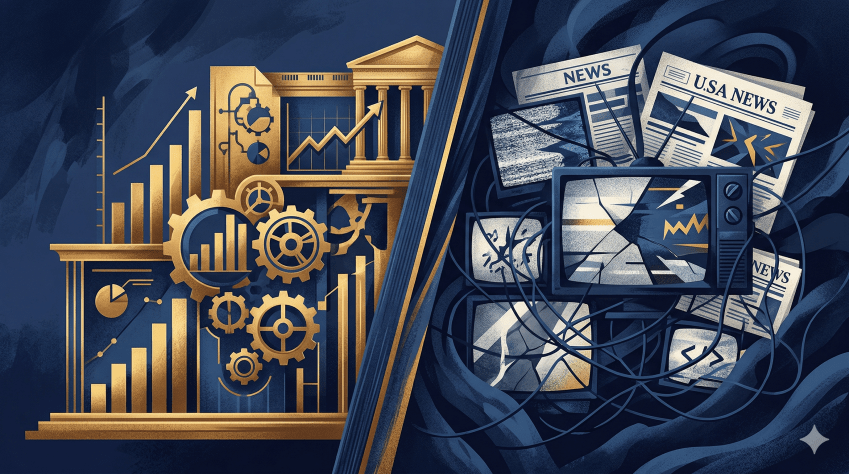
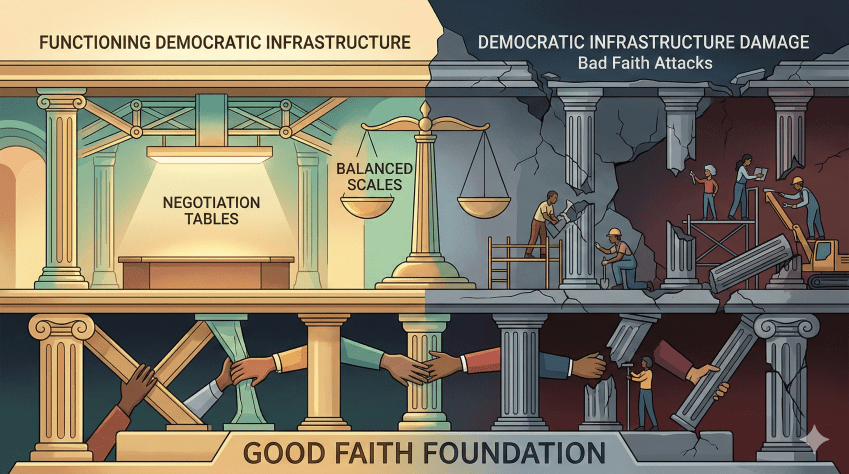
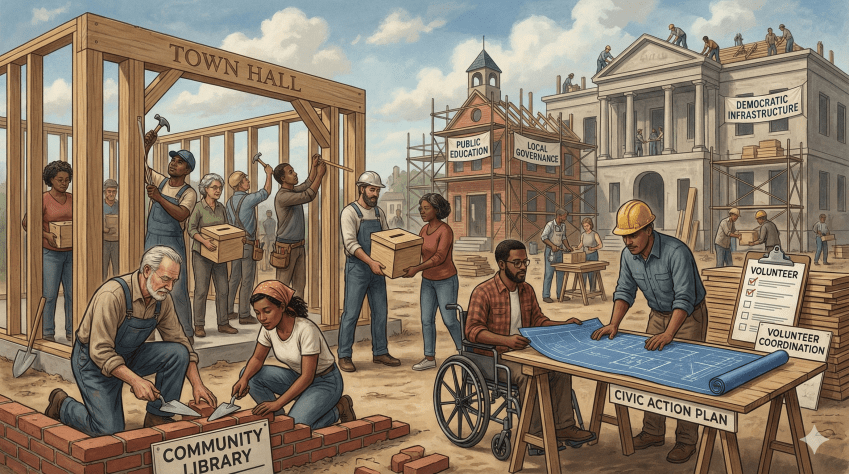
In 2025, I felt like the country died. American hope was never just a feeling—it was infrastructure. Systems of governance that made participation meaningful. Systems of information that made informed participation possible. Those systems have broken down. This essay diagnoses how that happened, and what rebuilding requires.
Venezuela Is a Symptom. Neo-Feudalism Is the Disease.
The U.S. military operation in Venezuela reveals a paradox: We claim we can’t afford to compete with China through infrastructure investment and development partnerships. But we can afford military operations seizing foreign assets.
This isn’t really about foreign policy. It’s a symptom diagnosing fifty years of systematically misapplying hard money mythology to a soft money economy. The result: strategic weakness forcing us to use military force where we lack capacity for partnership, and accelerating wealth concentration destroying the middle class.
In this essay, I examine:
– How monetary mythology created strategic weakness against China’s patient investment
– Who benefited from selective austerity (for you) and abundance (for them)
– Why Venezuela shows us becoming an isolated empire abroad and neo-feudalism at home
– What capacity stewardship means as concrete political action
This analysis transcends traditional left-right politics. It speaks to fiscal responsibility advocates, limited government advocates, opportunity advocates, and American strength advocates alike—because it’s grounded in economic reality rather than ideology.
The choice being made right now determines whether we preserve democratic capitalism or accept neo-feudal decline.
Defending Democratic Capitalism Through Capacity Stewardship
Part 3 of Defending Democratic Capitalism
For fifty years, you’ve been trapped in a false choice. The far right tells you collective action is theft. The far left tells you reform is betrayal. Both keep you passive while oligarchy consolidates power.
This essay reveals what both extremes hide: you can preserve American values and expand middle class power through capacity stewardship—making evidence-based decisions about what markets provide versus what requires public provision, demanding institutional quality that enables informed stewardship, and managing the economic transitions needed to make democratic capitalism work for everyone.
The core reframe: Government doesn’t need money like households. It creates money when it spends, constrained by productive capacity and real resources—not budgets. Once you understand this, the question changes from “can we afford it?” to “do we have the capacity to build it, and which mechanism (markets or public provision) best serves this need?”
But capacity stewardship requires institutional infrastructure: active Congress producing reports, investigative journalism exposing capture, universities generating valid knowledge, and science operating with integrity. The fifty-year assault didn’t just spread money mythology—it systematically destroyed the institutional capacity citizens need to steward democratically.
The path forward starts with conversation, not protest. Explaining how money actually works. Building understanding of your role as a capacity steward. Demanding quality from both markets and government. Expanding middle class power.
The American middle class was deliberately engineered by political leadership in the 20th century. That leadership is gone, compromised by oligarchs. The mechanisms remain. The work now falls to citizens.
Nobody is coming to save us.
Defending Democratic Capitalism from the Extreme Left
You’ve heard it: “Capitalism can’t be reformed.” It sounds principled. Who wants to collaborate with an exploitative system?
Here’s what’s actually happening: that position is strategic paralysis. While you debate revolutionary purity, concentrated wealth consolidates control through the democratic institutions you’ve abandoned.
In this essay, I expose how far-left arguments function:
– The structural absolutism declaring all reform as futile or collaboration
– How these positions share the same economic myths as the far-right
– Why retreat from federal power serves concentrated wealth perfectly
– How purity politics fragments coalitions while oligarchs consolidate unopposed
– Response templates for building effective coalitions despite these arguments
The evidence is clear: the New Deal, Scandinavian social democracy, and the GI Bill demonstrate democratic reform works. Denmark’s stronger safety net enables 30% higher business formation than the U.S. Institutional quality matters more than ideological purity.
This is Part 2 of a three-part series defending democratic capitalism from extremist attacks. Part 1 examined far-right libertarian positions. Part 3 will make the positive case for public money as democratic tool.
Defending Democratic Capitalism from the Extreme Right
You’ve heard it: “Taxation is theft.” Maybe from a libertarian uncle, maybe from a podcast, maybe in online debates. It sounds principled.
Who likes being forced to pay for things they don’t support?
Here’s what’s actually happening: that phrase is a weapon. A corporate-funded weapon designed to eliminate the only tool (democratic government) capable of constraining concentrated wealth.
For fifty years, far-right rhetoric has been dismantling democratic capitalism. Every time someone says “taxation is theft,” they’re attacking the legitimacy of democratic collective action itself. When all collective action becomes “violence,” oligarchs operate without democratic accountability.
In this essay, I expose how these arguments actually work:
– The core philosophical contradiction that makes libertarian framework self-defeating
– The corporate funding behind these arguments (billions invested since the 1940s)
– Six rhetorical techniques designed to manipulate you into accepting oligarchy
– Five economic myths exploited to make collective action seem impossible
– Specific response templates for defending democratic capitalism in real conversations
This is Part 1 of a three-part series. Part 2 examines far-left constraints on democratic capitalism. Part 3 makes the positive case for public money as the tool enabling broad prosperity.
Obamacare Succeeded at Health Insurance but Was Always Doomed to Fail at Healthcare
Obamacare achieved what it was designed to do: expand insurance coverage. But it was never designed to succeed at healthcare, and it never could have been. Two interlocking mythologies constrain American healthcare imagination: an economic mythology that makes fiscal limits appear natural, and a political mythology that makes universal programs appear ideologically dangerous. Together they create intellectual gridlock where voters cannot demand what they cannot imagine, and politicians cannot offer what voters will not accept. This essay deconstructs both mythologies piece by piece, revealing how Obamacare’s specific design choices were inevitable given the framework, and how the same framework constrains both parties. Once you see how the mythology works, you can break free from it and finally demand better.
Federal Taxes Don’t Fund the Government: We’ve Known This Since 1946
In January 1946, Federal Reserve Chairman Beardsley Ruml published an article explaining that the federal government doesn’t need tax revenue to fund its spending. He was describing the actual mechanics of sovereign currency systems after leaving the gold standard. We spent 80 years forgetting what he told us, and it’s time to remember.
How to Make Economics a Science
This essay develops a framework for assessing whether economics qualifies as a genuine science. Drawing on Popper’s falsificationism, Kuhn’s paradigm theory, and Merton’s norms of scientific communities, I identify six necessary attributes and apply them systematically to the discipline. The conclusion refines my earlier argument: economics as currently practiced is largely not a science, but it contains scientific elements and has the potential to become genuinely scientific. The critical failures include systematic refusal to abandon falsified theories, teaching operational falsehoods about monetary systems, and resolving disputes through institutional power rather than evidence. A companion piece to “Economics is not a Science” and draws on analysis from “Why Monetary Systems Matter” and “Why Economic Models Matter.”
Universal Basic Income (UBI) isn’t the right solution, the U.S. needs Universal Basic Assets (UBA)
Universal Basic Income (UBI) has captured progressive imagination as the solution to poverty and inequality. But the policy has a fatal flaw: cash transfers into markets with inelastic demand get captured by rent-seekers. Give everyone $1,000 monthly and landlords raise rent accordingly, healthcare companies raise premiums, and universities raise tuition. We’ve observed this pattern repeatedly with student loans, housing vouchers, and childcare subsidies. The purchasing power vanishes into the pockets of asset-owners while inequality remains unchanged.
This is why the United States needs Universal Basic Assets: providing what people need directly (housing, healthcare, education, transportation, utilities) as public goods and removing these necessities from extractive markets entirely. Quality implementation matters (Vienna, Singapore, and Germany prove this works at scale), and this isn’t about choosing between capitalism and socialism.
The real question is how we use our understanding of monetary systems to build institutions serving a pluralistic, diverse society where someone can choose quiet subsistence without stigma while their neighbor pursues wealth-building, and both have dignity, security, and genuine opportunity.
Beyond Capitalism vs. Socialism
For seventy years, American political discourse has been trapped in a Cold War binary that no longer serves us. While we debate whether government or markets should control the economy, countries from Singapore to Sweden have built prosperous societies by ignoring this false choice entirely.
This essay argues that the capitalism versus socialism framework obscures the real issue: most Americans fundamentally misunderstand how money works in the post-1971 fiat currency world. This misunderstanding – what I call macroeconomic illiteracy – has led us to accept artificial constraints on what’s possible, resulting in forty years of wage stagnation, wealth concentration, and declining public goods.
Drawing on my previous work on monetary systems, economic models, and hidden wealth transfers, I demonstrate why successful economies use markets for what they do well (discretionary goods) and non-market mechanisms for what they don’t (survival needs like healthcare and housing). The path forward isn’t choosing between markets and government but understanding our monetary reality well enough to use both effectively.
As democratic institutions face unprecedented threats and economic anxiety fuels political extremism, breaking free from obsolete ideological constraints isn’t just an economic necessity – it’s essential for preserving democracy itself.