This essay develops a framework for assessing whether economics qualifies as a genuine science. Drawing on Popper’s falsificationism, Kuhn’s paradigm theory, and Merton’s norms of scientific communities, I identify six necessary attributes and apply them systematically to the discipline. The conclusion refines my earlier argument: economics as currently practiced is largely not a science, but it contains scientific elements and has the potential to become genuinely scientific. The critical failures include systematic refusal to abandon falsified theories, teaching operational falsehoods about monetary systems, and resolving disputes through institutional power rather than evidence. A companion piece to “Economics is not a Science” and draws on analysis from “Why Monetary Systems Matter” and “Why Economic Models Matter.”
Universal Basic Income (UBI) isn’t the right solution, the U.S. needs Universal Basic Assets (UBA)
Universal Basic Income (UBI) has captured progressive imagination as the solution to poverty and inequality. But the policy has a fatal flaw: cash transfers into markets with inelastic demand get captured by rent-seekers. Give everyone $1,000 monthly and landlords raise rent accordingly, healthcare companies raise premiums, and universities raise tuition. We’ve observed this pattern repeatedly with student loans, housing vouchers, and childcare subsidies. The purchasing power vanishes into the pockets of asset-owners while inequality remains unchanged.
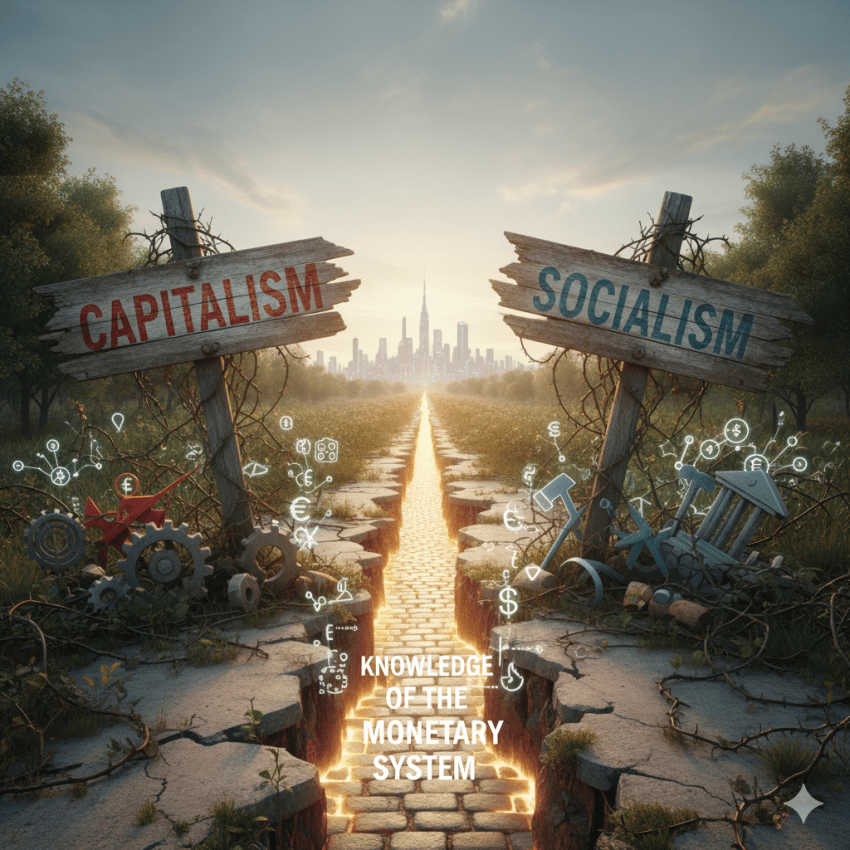
This is why the United States needs Universal Basic Assets: providing what people need directly (housing, healthcare, education, transportation, utilities) as public goods and removing these necessities from extractive markets entirely. Quality implementation matters (Vienna, Singapore, and Germany prove this works at scale), and this isn’t about choosing between capitalism and socialism.
The real question is how we use our understanding of monetary systems to build institutions serving a pluralistic, diverse society where someone can choose quiet subsistence without stigma while their neighbor pursues wealth-building, and both have dignity, security, and genuine opportunity.
Beyond Capitalism vs. Socialism
For seventy years, American political discourse has been trapped in a Cold War binary that no longer serves us. While we debate whether government or markets should control the economy, countries from Singapore to Sweden have built prosperous societies by ignoring this false choice entirely.
This essay argues that the capitalism versus socialism framework obscures the real issue: most Americans fundamentally misunderstand how money works in the post-1971 fiat currency world. This misunderstanding – what I call macroeconomic illiteracy – has led us to accept artificial constraints on what’s possible, resulting in forty years of wage stagnation, wealth concentration, and declining public goods.
Drawing on my previous work on monetary systems, economic models, and hidden wealth transfers, I demonstrate why successful economies use markets for what they do well (discretionary goods) and non-market mechanisms for what they don’t (survival needs like healthcare and housing). The path forward isn’t choosing between markets and government but understanding our monetary reality well enough to use both effectively.
As democratic institutions face unprecedented threats and economic anxiety fuels political extremism, breaking free from obsolete ideological constraints isn’t just an economic necessity – it’s essential for preserving democracy itself.
Why Monetary Systems Matter
This essay began as a response to a thoughtful Facebook comment expressing concerns shared by millions of Americans about inflation, government debt, and economic insecurity. The commenter blamed our problems on leaving the gold standard in 1971 and the government’s ability to ‘print money.’ While their frustrations are entirely valid, their diagnosis misses the mark. This piece examines three fundamental misconceptions about money, debt, and government spending that have dominated American economic discourse for forty years: and explains why correcting these misconceptions is essential for building broadly shared prosperity.
Why Economic Models Matter
A comprehensive response examining competing economic frameworks and their predictions about money creation, government deficits, and inflation. Using evidence from quantitative easing, Japan’s three-decade experiment, and the 2021-2022 inflation episode, this essay tests which theories actually explain how modern monetary systems work… and reveals why economics maintains failed models through institutional power rather than empirical success.
AdCP Launched Today. In 2 Years, You Won’t Log Into Ad Platforms
The revolution is the protocol. In advertising, protocols solve coordination problems at scale. For example, before RTB, buying from 50 publishers meant 50 different relationships and custom processes. RTB created a standard auction language—suddenly you could access thousands of publishers because everyone spoke the same way.
What is AI Psychosis? Why Using AI is very Different than a Google Search
The primary factor enabling AI psychosis is a mismatch between how easy AI systems appear to use and how difficult they are to use competently. This creates a dangerous overconfidence gap where people believe they’re operating sophisticated cognitive tools effectively while potentially degrading their own thinking capabilities.
The Irreducible Human Core: 8 Capabilities That Make You More Valuable Than AI
We already tried making humans into machines with SaaS workflows and ticket queues. Everyone lost. And now the real machines are here. AI can do a lot of things better than humans but here’s what it can’t do- and never will.
Thriving in the AI-Age: How to be a Generative Human using Generative AI as your Cognitive Workbench
A generative human is someone who uses AI to amplify their capacity to create original insights, novel solutions, and new value rather than just consuming AI’s outputs. Generative humans become more capable, more creative, and more valuable over time because each interaction with AI enhances their thinking abilities rather than replacing them.
Want to Use AI Better? Identify Your Use Case First
Since OpenAI’s GPT-5 model started rolling out last week, people ask me the same thing: “How do I use AI better?” The answer is simpler than you think, but it requires a shift in how you approach the problem. Instead of focusing on techniques and prompts, you need to identify your use case first.