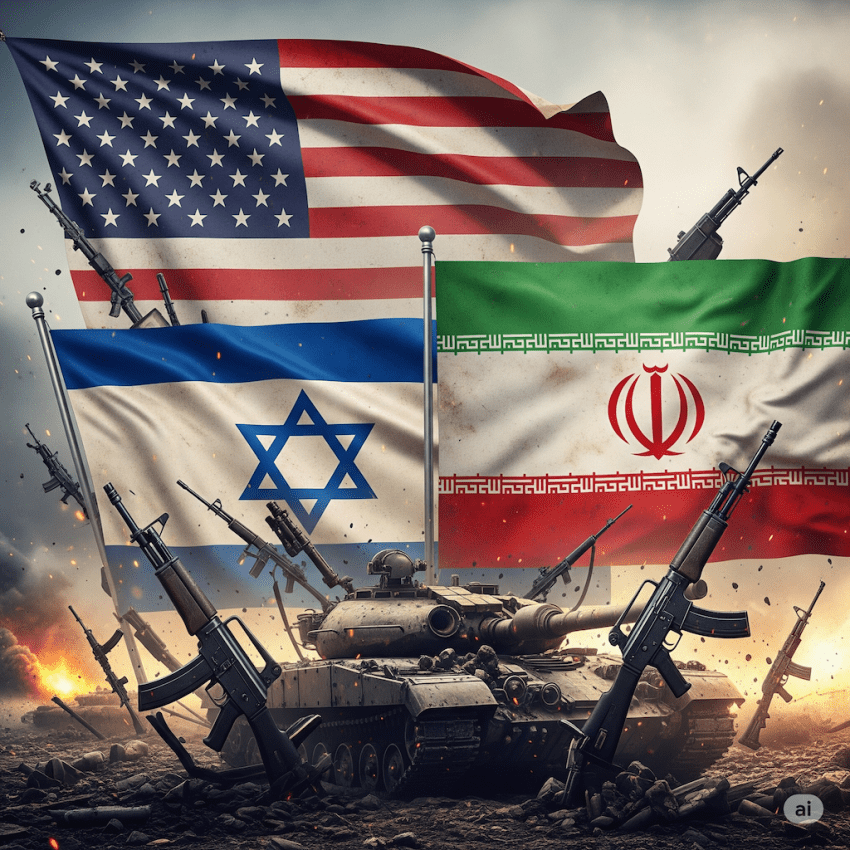
The Analytical Blind Spot: Missing the Religious Framework
Trump is a lifelong liar, manipulator and exploiter. This is well-documented by both his opposition and supporters—there’s no mystery here. Yet analysts, including Jay Kuo, keep writing narratives like: “Trump has repeatedly pitched himself as a peace candidate during his political career,” followed by surprise: “But if Trump is supposedly the America First / no foreign wars president…”
This completely misses how Trump operates. We all know his message adapts to whatever benefits him in the moment and that nothing he said in the past constrains what he does now. The deeper problem is that analysts are using the wrong framework entirely. Because Trump, the GOP and Big Tech have systematically destroyed the quality information supply chain, there is no shared truth or accountability to past statements—only personal truth shaped by algorithmic feeds.
When analysts try to hold Trump accountable by pointing to his previous promises, they miss that Trump operates through religious nationalism, not conventional politics. They’re creating “information noise” that feeds directly into his authoritarian agenda while completely missing what actually drives his decisions.
The Old American Political Framework Is Dead
For decades after WWII, both conservatives and liberals operated within a shared framework of national interest and what historians call the post-war liberal consensus. Reagan and Carter, Bush Sr. and Clinton—they disagreed on specific policies but shared basic assumptions about how America should engage with the world through institutions, alliances, and rational strategic thinking. They operated from a shared vocabulary and education about what constituted legitimate governance, democratic norms, and America’s role in the world.
This framework included traditions that made American politics a gold standard globally: respect for institutional norms, peaceful transfer of power, professional detachment in political discourse, and the presumption that political disagreements were about policy rather than fundamental legitimacy. Even fierce ideological opponents like Reagan and Tip O’Neill could work together and maintain personal respect.
Trump has abandoned this entirely. He’s not operating within any contemporary mainstream framework of traditional American conservatism or foreign policy realism (why I say Trump is anti-American). This is why analysts keep getting blindsided—they’re still using analytical tools designed for politicians who operated within that secular, institutional consensus. Trump operates through religious nationalism instead.
The Real Framework: Religious Nationalism, Not Secular Statecraft
Trump isn’t governing through secular policy frameworks—he’s driving toward authoritarian power through emotional manipulation via religious nationalism and racial resentment. Political commentators keep searching for coherent policy visions, but this fundamentally misunderstands how he operates.
Through this lens, potential Middle East war makes perfect sense. You can see this dynamic when Christians on social media get excited about their religion being “defended” against Islamic threats. With 62% of Americans identifying as Christian, that’s a massive voting bloc that can be mobilized through religious identity rather than foreign policy logic.
Trump’s Iran rhetoric isn’t about secular goals like nuclear proliferation or regional stability—it’s about activating deep-seated fears of a Muslim, non-white, non-Christian “other.” The policy details are irrelevant compared to the emotional power of standing up to an Islamic theocracy that conservative Christians have been conditioned to see as fundamentally opposed to their values. This pattern isn’t new—Trump has been doing this for at least 10-15 years at the national level.
How Religious Nationalism Controls the Narrative
This explains why conventional foreign policy analysis misses the mark with Trump. He’s not weighing diplomatic options or calculating geopolitical outcomes—he’s asking whether military action will energize his base and create opportunities for strongman posturing.
The right-wing media ecosystem has conditioned its audience to respond emotionally rather than analytically. Years of programming have primed conservative Christians to see conflicts with Muslim-majority nations as extensions of the cultural and religious battles they’re fighting at home. Fox News doesn’t just influence Trump’s decisions—it creates the emotional infrastructure that makes religious nationalism politically viable.
Whether military action succeeds or fails operationally doesn’t matter—what matters is whether it reinforces Trump’s brand as defender of Christian America against foreign threats. Even complete disasters can be reframed as evidence that Democrats or the “deep state” sabotaged righteous missions. The real victory is controlling the religious narrative, not achieving military objectives.
Trump’s Iran Calculus: Personal Power, Not American Interests
Trump’s Iran approach should be understood as authoritarian power consolidation through religious nationalism—not traditional foreign policy. Recent reporting provides perfect evidence of this calculation in action.
Trump has “approved of attack plans for Iran” but said he was “waiting to see if Iran would be willing to discuss ending their nuclear program,” giving himself a two-week timeline to decide. As Trump told reporters: “Based on the fact that there is a substantial chance of negotiations that may or may not take place with Iran in the near future, I will make my decision whether or not to go within the next two weeks.”
This isn’t military urgency—it’s political calculation. If this were about genuine national security threats, there wouldn’t be a leisurely two-week deliberation period. This timeline serves a different purpose: gauging Christian nationalist response, testing messaging with his base, and coordinating the media narrative that best serves his power consolidation.
The deeper insight is that Trump has limited control over what other parties will do. Iran might negotiate, Israel might achieve its goals independently, or the situation might escalate unpredictably. Since he can’t control these variables, Trump needs to be narratively prepared rather than militarily prepared. The two-week window isn’t about military readiness—it’s about ensuring he can frame any outcome as a victory for Christian America.
When Trump considers Iran, he’s not asking “What serves American interests?” but “What serves my grip on power through Christian nationalism?” Based on that calculation, war with Iran makes perfect political sense, regardless of what he said on the campaign trail. This is why I think Trump is fundamentally anti-American—he’s abandoned the secular, institutional framework that made America a beacon for democracy and replaced it with religious authoritarianism that serves his personal political survival.
Fighting for America’s Democratic Soul: Responding to Christian Nationalism with a New Democratic Party
What’s at stake in this fight isn’t just electoral politics—it’s the fundamental character of America itself. For generations, America’s democratic soul was defined by the radical idea that people of different faiths, backgrounds, and beliefs could live together as equals under a secular constitution that protected everyone’s rights. This is what made America exceptional: not Christian supremacy, but pluralistic democracy.
The rise of Christian nationalism demands a response equal to the threat. People who oppose Christian nationalism must unite under the Democratic Party banner and transform it into something new—forcing out whatever the old Democratic Party was and building a movement capable of defending pluralistic democracy. This isn’t about loyalty to existing Democratic leadership or past Democratic priorities. This is about survival of democratic governance itself.
While people who are racists, bigots, nationalists, fascists and libertarians are wholly hopeless to this cause, everyone else are natural allies who share concerns about the direction the country is being taken. But good intentions aren’t enough. We need to take over the Democratic Party and make it the vehicle for defending America’s democratic foundation against religious authoritarianism.
This new Democratic Party must explicitly champion pluralistic democracy against Christian supremacy. It must recruit and empower Christians who believe in plurality, supporting their efforts to frame opposition to unnecessary wars as moral imperatives rooted in peacemaking and stewardship. It must reject the old Democratic playbook of technocratic policies and embrace the existential fight for America’s constitutional character.
The window for this transformation is closing. We are at least 10 years into the authoritarian grooming of America, with an entire media apparatus supporting religious nationalism. Half-measures and business-as-usual Democratic politics will not meet this moment.
The hard reality is that if you are against Christian nationalism, you have to unite and force this transformation of the Democratic Party. Whatever you might think about the Democratic Party or what it meant to you before, this is what it must become now: the vehicle for defeating nationalist fascism and religious fundamentalism. There is no third option when democracy itself is under assault.
As a GenX, non-Christian born and raised in Utah, I lived a great life alongside Christians who never judged me for my beliefs and I did not for theirs. I’ve experienced both the end of the Cold War consensus and the rise of internet/social media disruption that destroyed our shared information space. I know some of this language is strong, but I know what we are losing because I lived it: an America for all people.
This is the fight for America’s democratic soul, and it requires building a new Democratic Party from the ground up. I won’t stand silent while the pluralistic Christian community I grew up with gets consumed by authoritarianism—and neither should anyone else who believes in the America that welcomes all people under one constitutional roof.