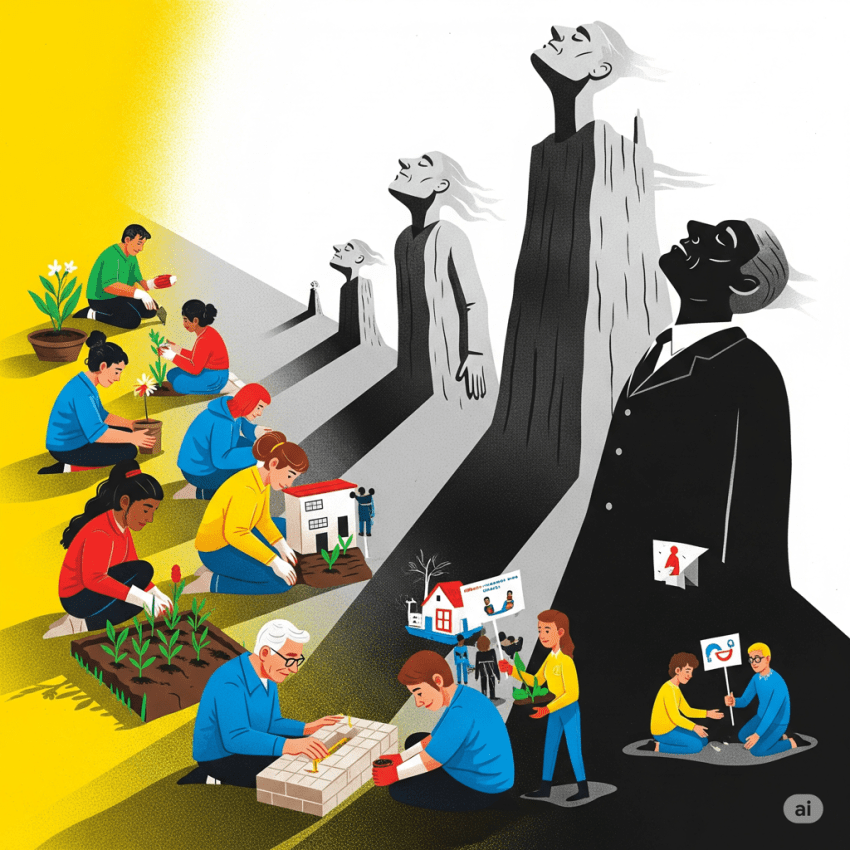
The retreat from federal power is exactly what corporate interests want—here’s how to fight back with systems that actually work
Cross-posted to Substack
What I Really Think About Community Wealth, Social Enterprise, and Wellbeing Economies
I think community wealth building, social enterprise, and wellbeing economies represent some of the most important innovations happening in America today. They offer genuine pathways for ordinary people to build economic security, pursue meaningful work, and create alternatives to extractive capitalism. But here’s where I part ways with many progressives: I think the way we’re approaching these solutions is strategically dangerous.
A troubling pattern has emerged within progressive politics: widespread frustration with corporate control over federal politics has led progressives to retreat from building strong, well-resourced national systems. Instead, they’re focusing on local control and smaller communal systems—unwittingly playing right into the hands of authoritarians and corporate interests who want Americans divided and resource-poor.
I think this retreat stems from a widespread misunderstanding about how our monetary system works—the persistent belief that “we can’t afford anything” or that ambitious programs will “blow up the national debt.” Without knowledge about how modern economics actually works, progressives lack a framework to think about action beyond what is close to them and controllable through their own efforts. This retreat enables the very consolidated power and corporate interests progressives oppose.
Why Local-Only Solutions Can’t Scale
Here’s my core concern with how we’re currently approaching community wealth, social enterprise, and wellbeing economies: they’re fundamentally constrained by local income, which is ultimately limited by local economic activity. A community can only support as many cooperatives or social enterprises as the local economy can sustain.
Without connection to national resource allocation systems, these initiatives will always be weak and fragile—dependent on immediate economic health and vulnerable to downturns, industry changes, or demographic shifts. Think practically: if your town’s main employer closes, all the community gardens and local cooperatives in the world can’t replace that lost economic foundation.
This is why inspiring community development projects remain small-scale demonstrations rather than genuine economic alternatives. They’re trying to build independent autonomy and power without access to the systematic resource flows that make wealth-building possible.
Meanwhile, progressives are focusing their energy on small-scale solutions—community gardens, local cooperatives, personal lifestyle changes, and neighborhood organizing—as well as personal development and introspection. While these efforts are valuable, treating them as substitutes for national engagement fundamentally misunderstands how power and resources work in modern America.
The Fiscal Myths That Keep Us Small
The progressive retreat from building national systems often stems from accepting false beliefs about government finances that actually help maintain corporate control. When community organizers believe that transformative programs require “finding the money” through higher taxes or spending cuts elsewhere, building strong national systems seems impossible.
Here’s what changed everything: Understanding how our monetary system actually works reveals this retreat as based on fundamental misunderstandings. The federal government doesn’t need to “find” money to fund strong national systems—it creates money, just as it does for military spending and corporate subsidies. The real constraints are whether we have enough workers, materials, and organizational capacity, not whether the government has enough money in its accounts.
Since 1971, when President Nixon ended the gold standard, we’ve lived in a “soft money economy” where money is created and managed by the government to coordinate economic activity. Money isn’t scarce like gold—it’s more like a measurement system that helps organize who produces what and who gets access to goods and services.
The irony is profound: progressives are retreating from systems building precisely when understanding how our monetary system works could provide tools to build national systems that challenge corporate control systematically. When progressives accept hard money constraints that don’t actually exist, they retreat from building the strong national systems that could provide genuine alternatives to corporate control.
How Community Wealth Could Actually Scale
The key insight is this: community wealth initiatives need access to national-level resources to become truly competitive and resilient. Right now, they’re constrained by local economic capacity—a cooperative can only grow as large as the local economy can support, and a community land trust can only acquire as much land as local residents can afford.
But what if we connected community wealth building to systematic resource flows? What if local cooperatives had access to zero-interest federal loans? What if community development projects could draw on national funding streams designed specifically to support local control and decision-making?
This isn’t about federal micromanagement—it’s about federal resource capacity enabling genuine local autonomy. The money flows from national systems, but communities decide how to use it based on their specific needs and priorities.
Here’s what this could look like in practice:
Federal Job Guarantee: National Funding, Local Projects
A job guarantee program would distribute federal funds through state and local governments to address development issues that markets don’t handle well—environmental restoration, community infrastructure, care work, and cultural preservation. This creates direct pipelines from national resource capacity to local community needs.
I’ve seen this work with Superfund cleanup in my hometown of Salt Lake City, Utah, one of the most industrial, tech-forward and thriving places in the United States. Federal resources enabled ambitious environmental restoration that would have been impossible with local resources alone.
This system serves essential economic functions: it acts as a countercyclical balance (expanding when the economy slows, contracting when it heats up), pegs the value of money to labor by establishing a wage floor, provides inflationary controls, creates a skills development pipeline, serves as economic insurance during automation transitions, and addresses market failures where essential but unprofitable work goes undone.
Crucially, local administration keeps programs focused on genuine value while ensuring community accountability. What’s needed in Clarksdale, Mississippi is different than what’s needed in Billings, Montana. This becomes powerful infrastructure for building economic confidence and opportunity.
Community-Controlled Banking: Learning from Germany
Instead of forcing community development projects to compete for limited private bank funding, we could build banking systems focused on local development with strong community input. Germany’s Sparkassen system shows how this works: roughly 400 local savings banks representing 15% of the country’s banking assets, operating with a public mandate for regional development, where success is measured by community impact rather than just profit.
Universal Basic Assets: Beyond Individual Survival
Understanding how government spending actually works enables universal basic assets—ensuring everyone has access to housing, education credentials, productive tools, and community ownership stakes. This creates the foundation for sustained community engagement and the confidence to pursue opportunities rather than just survive.
Even in good economic times, many people want to do community development and social support work—work that’s essential but goes underfunded because it doesn’t generate immediate profits. With proper systematic support, we can build meaningful careers around this important work rather than forcing people to choose between financial security and community service.
The Geopolitical Stakes of Going Small
There’s a crucial dimension that progressives often miss: we cannot be geopolitically secure and advocate effectively for our values if our national systems are weak and our people are fragile. When Americans struggle with basic economic security due to weak national systems, the United States loses credibility and influence globally. Authoritarian regimes point to American inequality and dysfunction as evidence that democratic capitalism doesn’t work.
The progressive retreat from building national systems inadvertently weakens America’s position globally by abandoning the tools needed to build genuine national strength. When progressives retreat from building national systems, they’re effectively ceding global leadership to nations that understand the connection between strong domestic systems and international influence.
Understanding how our monetary system works reveals that America has unique advantages for building strong national systems (I’m focusing on domestic benefits here—our position as the global reserve currency deserves separate discussion). Using these advantages to build systematic economic security isn’t just good domestic policy—it’s essential national security strategy that demonstrates democratic capitalism’s ability to deliver shared prosperity.
As I like to say, “Capitalism and Democracy, two great tastes that taste great together.”
My Real Assessment: Tremendous Potential, Wrong Strategy
So what do I really think of community wealth, social enterprise, and wellbeing economies?
I think they offer genuine alternatives to extractive capitalism and provide pathways for ordinary Americans to build economic security and pursue meaningful opportunities. They represent the future of American economic development. But treating them as small-scale alternatives to national engagement fundamentally misunderstands how power and resources work.
The United States already has extensive examples of these approaches scattered across the country. What it lacks are strong national systems that would scale these approaches into genuine alternatives while creating conditions where ordinary Americans can pursue opportunities, take meaningful risks, build economic security, and act with confidence.
This is where individual wealth building and innovation comes from—not from retreating into under-resourced local solutions, but from having systematic support that enables people to take risks and pursue opportunities.
We have evidence for this: every TikTok talks about how baby boomers have so much wealth compared to contemporary generations. Baby boomers hold 52% of America’s total wealth while millennials, despite being the largest workforce, own just 6.5% of total wealth—making boomers more than 8 times wealthier than millennials. The average millennial has 30% less wealth at age 35 than baby boomers did at the same age. This dramatic difference exists because boomers benefited from systematic federal policies designed by American policymakers generations before them that allowed the power of the middle class to emerge.
The GI Bill provided almost 8 million WWII veterans with funds for college education, business loans, and home purchases—with 2.2 million using it for higher education and 4.3 million receiving home loans. As historians note, “The G.I. Bill helped make U.S. democracy more vibrant in the middle of the twentieth century” by enabling working-class veterans to move into the middle class. The Federal Housing Administration, created in 1934, revolutionized home ownership by insuring mortgages and allowing monthly payments instead of balloon payments, contributing to homeownership rising from 44% to 63% between 1934 and 1972.
These weren’t small programs—they were systematic federal investments that created the foundation for decades of prosperity. The same systematic support that built the post-war middle class is exactly what community wealth, social enterprise, and wellbeing economies need today to become genuinely competitive alternatives within our capitalist system.
My assessment is ultimately optimistic, but only if we have the strategic wisdom to build the national systems needed to support these approaches at scale. The question becomes not whether we can afford to build community-controlled economies, but whether we have political will to build the national systems needed to make community wealth, social enterprise, and wellbeing economies genuinely competitive alternatives to corporate capitalism.
From Analysis to Action: Building Political Alternatives
As I’ve argued throughout this essay, we need to move beyond false choices and build systems that create genuine alternatives. This applies not just to economic policy but to our political system itself. Though I am a party of one, I am tired of the anti-competitive, duopolistic political system we live in. We need more alternatives, which is why I am starting the Opportunity Party.
Maybe we can build a new collective voice that can drive an agenda giving opportunity to all Americans regardless of beliefs, culture, or lifestyle. The same systems thinking that reveals how we can build strong national infrastructure for community wealth can help us build new political infrastructure that breaks us out of tired left-right debates that prevent us from using our full economic potential.
The Bottom Line
Community wealth, social enterprise, and wellbeing economies could transform American economic development from fragile survival strategies into powerful alternatives—but only if we stop treating them as alternatives to federal engagement and start building the systematic support they need to compete with corporate power.
The progressive retreat from building strong national systems is happening precisely when systematic federal support could make these approaches genuinely transformative. The choice isn’t between pure localism and corporate control—it’s between systematic support for democratic alternatives and continued retreat while others shape an increasingly divided and powerless present.
The question is whether progressives will engage with the systematic work of building strong national systems that create genuine freedom and opportunity, or continue withdrawing into well-intentioned but under-resourced local solutions while authoritarians and corporate interests build the systems that will actually shape America’s future.