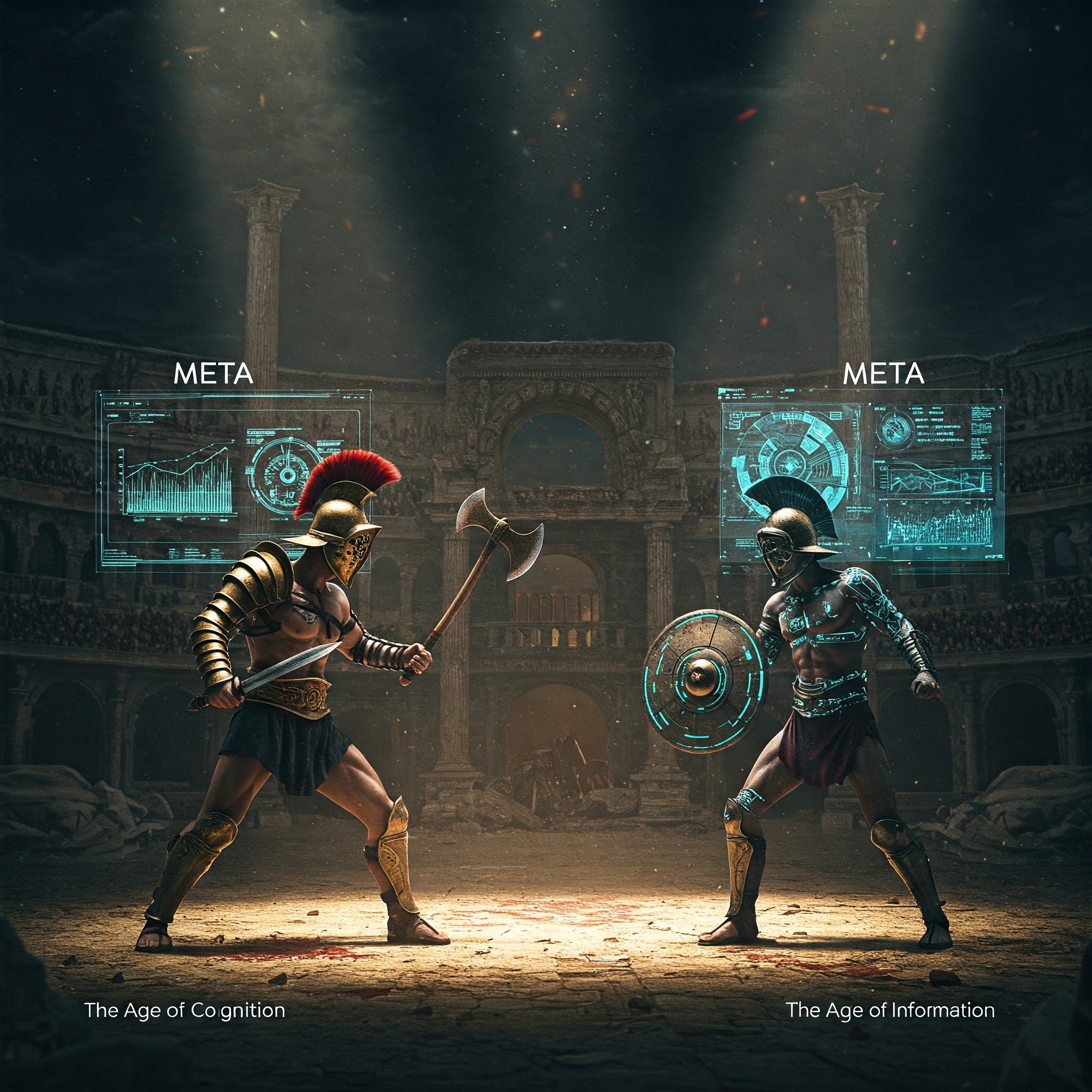
“Everyone’s playing checkers. Zuckerberg’s playing Monopoly.”

That’s the vibe online right now. But it misreads the moment.

What looks like consolidation might actually be repositioning.

Meta isn’t cementing its dominance—it’s trying to survive the collapse of the game board itself.
This past week, Mark Zuckerberg made headlines with a bold new vision for Meta’s ad platform: soon, small businesses won’t need to worry about creative, targeting, or even analytics. All they’ll need is a goal and a budget. Meta’s AI will handle the rest—automatically generating content, selecting the audience, optimizing the spend, and reporting the results. For many, it sounded like the final boss move from a platform giant: erase the middlemen, swallow the stack, and own the entire funnel.
That interpretation isn’t wrong on the surface—but it misses what’s really happening underneath. Meta isn’t doing this because it’s confident. Meta is doing this because it has no other move.
To understand why, we have to look at where Meta fits in the broader ecosystem of the tech economy. Google owns the tools layer—search, calendar, maps, Android. Amazon controls intent-to-purchase infrastructure, from product search to delivery logistics. Microsoft dominates enterprise productivity, developer platforms, and cloud services. Even Netflix, Apple, and Spotify anchor their ecosystems with premium content and cultural IP. But Meta? It doesn’t own a tools layer, a cloud stack, or a retail arm. It doesn’t make hardware people depend on. It has no real foothold in business infrastructure. What Meta has—and all it has—is attention: social feeds, behavioral data, and an advertising engine optimized for the Browsing Era.
And that era is ending.
As I wrote in The End of Browsing, we’re exiting a time when the internet functioned like a giant catalog—designed for people to click, explore, compare, and eventually choose. Browsers were the default interface. Platforms optimized for visibility. Brands fought to appear in just the right spot. Meta won big in that world because it turned attention into an economy. But the mental model of the internet as a place we navigate is giving way to something else: a world where the internet responds to us. Browsing is being replaced by delegation. The interface is no longer a screen—it’s a prompt. And when we no longer navigate but instead request, the entire architecture of scroll-based advertising begins to unravel.
We no longer browse when we can prompt. We no longer search when an assistant can decide. AI-native systems like ChatGPT, Gemini, and Claude aren’t just tools—they’re interfaces that act. They don’t organize pages. They interpret goals. They don’t show options. They complete tasks. If I can say “find me the best running shoes for under $100” and the system delivers the answer directly, there’s no ad to click. No feed to scroll. No funnel to optimize. The traditional pathways collapse.
This is the deeper shift I laid out in The Agent Is the Internet. The web is no longer a place we move through. It’s becoming something we speak to. Something we delegate to. We are shifting from a navigation-based experience to a cognition-based one. From links to relationships. From discovery to orchestration. This isn’t just a change in tools—it’s a full shift in how the digital world organizes action, memory, and trust.
We’re not just witnessing the evolution of ad platforms—we’re living through a phase shift in the digital environment itself. The Information Age, which organized the internet around content, clicks, and visibility, is giving way to something else: the Cognition Age. In this next chapter, what matters isn’t how much is shown—but what is understood and acted on. It’s not just about access to data. It’s about systems that can interpret goals, hold context, and execute with alignment. And that shift changes everything—from how we design platforms to how we define agency.
Meta sees this happening.
It knows that if people begin routing intent through agents rather than platforms, it risks being bypassed entirely. Google still has the tools. Amazon still owns the transaction layer. Microsoft still anchors the enterprise. Meta? If the feed stops being the interface, it disappears from the value chain.
That’s what makes Zuckerberg’s move so revealing. He’s not simplifying advertising. He’s trying to recast Meta as an AI-native fulfillment engine—a system that doesn’t just show ads but delivers outcomes. In that world, a small business doesn’t need to know who to target or how to test messaging. They just need to say what they want—and Meta’s system takes care of the rest. It’s an attempt to stay relevant in a world shifting from visibility to delegation.
This isn’t about dominance. It’s about adaptation.
Because if OpenAI becomes the default layer for digital interaction—if people begin prompting systems instead of browsing interfaces—Meta’s traditional stack collapses. There’s no room for advertising in a world where people don’t scroll. No targeting in a world where agents already know your needs. That’s why this move isn’t just another round of ad-tech automation. It’s a scramble to reposition before the next platform layer closes in.
In this new era, the core question isn’t “how many people saw the message?” It’s: did the system understand what the user wanted, and did it deliver the right thing in the right way? Attention may still matter, but not as a commodity. It matters as a signal of trust, of context, of intent. Execution becomes the product. Relationship becomes the interface.
We are entering the Cognition Age—an era where the internet no longer asks for clicks but for clarity. Where the winners won’t be those with the most content, but those with the most alignment. Where the question shifts from visibility to relevance, from reach to response. What matters now is not how far the message travels—but whether the system acts wisely on your behalf.
A lot of people see Meta’s announcement as the final power move of a dominant tech giant. But I see it differently. To me, it looks like the first real sign of a company trying to escape the limits of the Web 2.0 world it helped build. The old rules are breaking down, and Meta knows it. This isn’t just about changing how ads work—it’s about trying to stay relevant in a future where the way we interact with technology is changing completely.
It’s easy to read moves like this through the lens of dominance—through what can be taken, controlled, or collapsed. But sometimes what looks like consolidation is actually repositioning. What looks like a bold offense may be a quiet retreat from structural exhaustion. The systems we’ve built are beginning to invert their logic. Visibility isn’t leverage. Insight isn’t output. The future won’t be owned by those who extend the last map, but by those who notice the terrain is changing beneath their feet.
The real question isn’t about who wins the current stack. It’s about what kind of architecture we’ll need for what’s coming next. Not just who acts, but who understands. Not just who holds the prompt—but who the prompt trusts to respond.
The interface is changing. The economic center of gravity is shifting. And the window to shape what comes next is still open—for now.
Chevan
This is only the beginning. Future explorations will map the architectures of agency, trust, and cognition that will define the next era.