How the Leveraged Buyout Actually Works, and Why This Is a Failure of Democracy Rather Than Capitalism
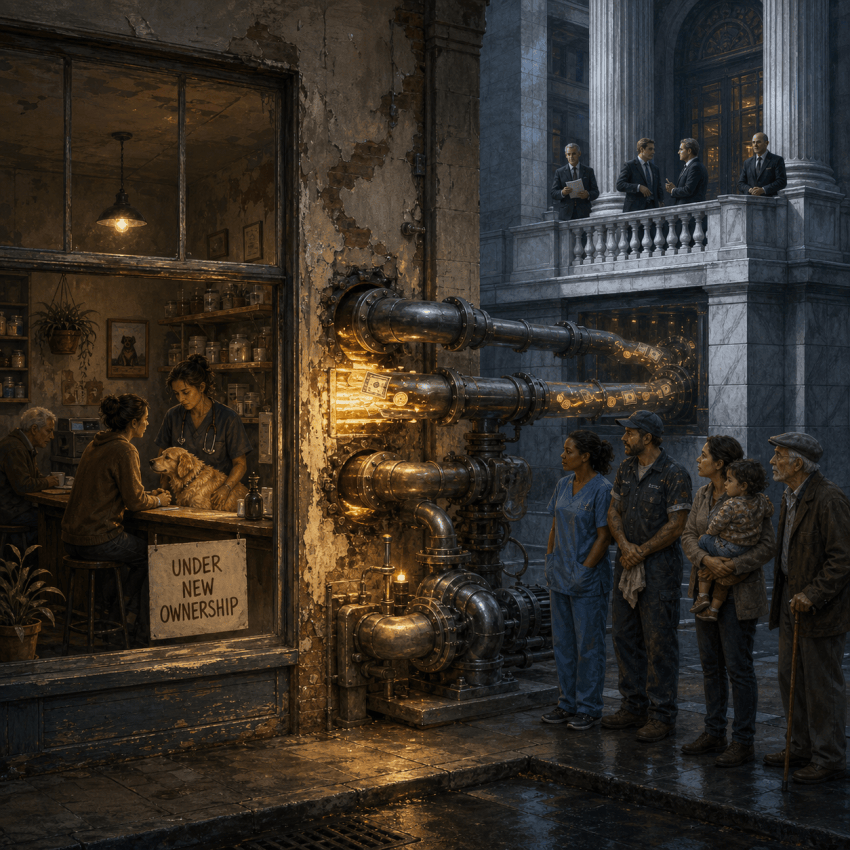
PE has become a four letter word for most Americans. We have all experienced the symptoms, and without any research we know the cause. A beloved food brand, a local vet, a small cafe gets “acquired.” Over the next few years everything you loved about it turns rancid, and you know why: private equity.
But knowing the name is not the same as knowing the mechanism. This essay is about the specific arrangement that produces the rot across dozens of industries at once, and about why we do not stop it. For most of the last century, American democracy actively governed capitalism to public purpose, adjusting the rules whenever markets began to hurt the people they were supposed to serve. That is what the antitrust laws of the early 1900s were, and the banking rules of the 1930s, and the pension protections of the 1970s. Then it spent five decades stepping back from that work. The rules changed and made room for what came next. Private equity is what happened in the space the old rules used to fill. What we are looking at is a failure of democracy, not a failure of capitalism, and the difference points at what to change.
What the thing is
A private equity firm raises money from pension funds, university endowments, insurance companies, sovereign wealth funds and rich individuals. It pools that money into a fund, then uses the fund plus a much larger amount of borrowed money to buy companies outright. It holds each company for a few years, reorganizes it, and sells it or takes it public. Along the way the firm charges a fee for managing the money, and at the end it keeps a share of the profits.
The word private refers to what happens to the companies. A public company files quarterly reports, discloses executive pay, and answers to anyone who buys a share. Take it private and those obligations end. Ownership becomes hard to trace, the numbers stop being published, and the people affected by the decisions lose the ability to see who is making them.
Very few people will ever put money into a fund like this. Most of us hand money to the companies these funds own every week without knowing it.
There is a second, quieter piece of this. In 1974 Congress passed a law called ERISA that governs how pension funds invest their money. In 1979 the Labor Department clarified the law in a way that let pensions put money into private equity funds. That single interpretive change opened one of the largest pools of capital in the country to these firms. The practical effect is a loop. A teacher’s or nurse’s pension pays into a fund. The fund uses that money, plus much larger amounts of borrowed money, to buy the company where somebody’s spouse works. A few years later the company is loaded with the debt that bought it and sold or bankrupted. The paper the pension holds is worth what is left. The worker pays for it, holds a share of it, and cannot see any part of the arrangement. Making that hidden share visible is the argument I make elsewhere for universal basic assets, in UBI vs UBA.
What you experience
It arrives as a set of small degradations that seem unrelated to each other.
The dentist’s office you have used for years is part of a chain now. The hygienist you liked has left, appointments run shorter, and you are being sold treatments nobody mentioned before. The veterinary practice down the road changed hands and the bill for the same annual visit went up by half. Your building was sold, maintenance requests stopped being answered, and a monthly fee appeared on the rent statement for something that used to be included in the rent.
You went to an emergency room that was in your insurance network, and the bill came from a doctor who was not, because the hospital had contracted its emergency staffing out to a separately owned company. You had no way to know that, and no ability to shop for a different doctor while you were on a gurney. The nursing home where your father lives runs fewer aides on the overnight shift than it did last year, and the ones who remain are covering more residents each. The retailer you grew up with emptied out over a few years, stopped carrying much of anything, and closed.
None of this arrives with a label. The name over the door usually stays the same, which is deliberate. The change happens upstream, in who owns the business, what they need it to produce, and how quickly they need it.
What these situations have in common is a business that used to be run to serve its customers and is now run to service its debt. How that debt got there is the whole argument.
The exchange that prompted this
I said a version of this on a thread recently: that a business model built on asset stripping and debt loading should not exist, and that it does nothing for society. The first reply dismissed the point by accusing me of being against economic freedom. Then someone asked a fair question. If one business buys another for the sole purpose of shutting it down, would I ban that too?
My answer was, yes, and we mostly already do. Buying a competitor in order to close it is a classic antitrust violation, because the harm to society is easy to see: one fewer option, less competition on price, less pressure to invest in quality. The question is worth answering at length anyway, because it forces the objection to be stated precisely. Nobody sensible objects to companies changing hands. Nobody sensible objects to businesses closing, since an economy where failing firms cannot die is an economy that stops working. Evolution, innovation and progress are built into capitalism, and they are the reason we recoil from centrally planned production, where bad products never die and better ones never arrive. But losing competition produces the same dead end from the other direction. The real fight is not capitalism versus socialism. It is against actual monopoly, and against financial transactions built to cut the stakeholders out. In the case of private equity, the objection runs to a specific financial structure that separates the people making decisions from the people who live with them, then sends the gains toward the first group and the losses toward the second.
Economic freedom is the standard reply, and for a long time ordinary Americans had no vocabulary to answer it. After fifty years of watching the middle class get crushed, I think we can see it now. The phrase points at something that seems reasonable: a conference room, two sets of lawyers, a seller who wanted to sell, a buyer who wanted to buy, everyone signing willingly. Nobody was coerced. Framed that way, objecting to the deal means objecting to adults making their own arrangements, which sounds like a preference for having bureaucrats run the economy.
The frame leaves out the stakeholders I named a moment ago: everyone who was not in the room. The cook in the restaurant chain being purchased was not there. Neither was the town whose hospital sat in the portfolio, nor the small supplier who will go unpaid in a bankruptcy three years from now, nor the resident in the nursing home. They signed nothing. They cannot walk away from the result. The freedom being praised is not theirs, and it is being exercised on them. Environmental economics has a name for costs that land on people outside a transaction: externalities, and the discipline insists they be counted. Stakeholder thinking, which I laid out in The Politics of Stakeholder Society, makes the same insistence about deals like these. A financial transaction is never only about the money, because its social consequences land on people who never signed. This is where Milton Friedman’s famous claim, that the only social responsibility of business is to increase its profits, shows what it is: a blunt instrument, hollow about the one thing that counts… people.
Economic-freedom rhetoric slides quietly between two different things here. There is freedom to do things, which is what the phrase usually points at, and there is freedom from being coerced, which is what most people actually care about. Coercion by government is visible: laws are debated, votes are held, agencies answer to elected officials, and citizens can push back when they think the coercion isn’t legitimate. Coercion by a private buyer with concentrated capital is invisible: it happens through prices, wages, staffing decisions, and contract terms nobody outside the room saw negotiated. In a tradeoff between the two I take the visible kind under democratic control every time, because it is contestable. What we are watching now is a steady shift of power from the visible kind into the invisible kind, and the vocabulary of freedom makes the shift sound like liberation.
Someone who has never been shown how these deals are assembled has no way to know any of this. So here is how they are assembled.
What capital is supposed to do
There are two ways to fund a business. You can sell a piece of it, which is equity, or you can borrow, which is debt.
Equity carries the risk. If the business fails, the owners are wiped out before anyone else loses a dollar. That exposure is the entire moral case for the returns equity earns. You put your money at risk, you accept that you might lose all of it, and in exchange you keep the upside if you were right.
Debt sits ahead of equity in line. Lenders get paid before owners, they get paid a fixed amount rather than a share of the profits, and if the business collapses they have first claim on whatever can be sold. Less risk, less reward. That ordering matters enormously, and it is worth being concrete about what the line looks like when a company goes under. Secured lenders are paid first from the sale of the assets. Then the lawyers and bankers running the bankruptcy. Then a limited category of priority claims, including some unpaid wages, up to a capped amount. Then everyone else, meaning suppliers, landlords, customers holding gift cards, workers owed severance. Owners get whatever is left, which is almost always nothing. That is the design, and the design is defensible: the people who chose the risk lose first.
Everything defensible about capitalism depends on that ordering holding. It is what allows an economy to learn. Back a good bakery and you make money and can open two more. Back a bad one and you lose your savings and stop opening bakeries. Bread gets better and cheaper over time because people who guess wrong run out of money with which to keep guessing.
Limited liability changed this system without abandoning its logic. Shareholders are not personally liable for a corporation’s debts, a deliberate policy choice made so that strangers could pool money to build railroads without risking their houses. Investors would risk what they put in and no more. They still lost that.
What a leveraged buyout actually does
Start with an ordinary purchase. A company with cash buys a rival, pays for it out of its own funds, and closes it down. If that turns out to be a mistake, the buyer eats the loss. Its money is gone. That is a bet, and the person making it is the person carrying it.
A leveraged buyout works differently, and the difference is the entire subject of this essay.
Take an illustrative case with round numbers. A fund buys a company for a billion dollars. It puts in three hundred million of its own investors’ money and borrows the other seven hundred million. The borrowed money does not go on the fund’s books. It goes on the books of the company being purchased. The company has just been made to borrow the money used to buy itself, and from that day forward it must pay the interest out of its own sales.
Nothing about this is hidden or unlawful. It is the standard structure, and lenders know exactly what they are financing.
Look at what it does to the distribution of risk. The fund is exposed for three hundred million. Its other funds, its other companies, and the partners’ personal wealth are all beyond reach, because each acquired company is held in a separate legal entity. The purchased company is exposed for the full seven hundred million, money it never received and from which it got nothing. The people who work there, the suppliers who extend it credit, the landlords who lease it space and the customers who depend on it are exposed to whatever paying that interest does to the operation, and none of them were in the conference room.
Now the money starts moving outward, on a schedule set in advance.
The fund charges the company for managing it. Management fees and monitoring fees flow from the company to the firm that bought it, quarterly, regardless of how the business performs.
The fund may run a dividend recapitalization. This means having the company borrow still more money and hand the proceeds to the fund as a dividend. The fund gets cash now. The company gets a larger interest bill forever. In plain terms, the owner borrows against the business and keeps the money, and the business is left to make the payments.
If the company owns its buildings, the fund can execute a sale-leaseback. The real estate is sold to a property investor, the fund takes the proceeds, and the company continues operating in the same buildings, now as a tenant paying rent it never had to pay before. A hospital that owned its campus outright and had no mortgage now has a permanent lease expense that must be covered every month before it buys a single bandage. That rent has to come from somewhere, and in a hospital it comes from staffing.
Each of these moves takes value out of the company and returns nothing to it. Each one is booked long before anyone knows whether the business has actually improved. The fees are paid whether the turnaround happens or not.
That is the crux. If the operation thrives, the fund collects. If the debt crushes it, the fund has already collected, and the losses fall down that bankruptcy line described above, where workers and suppliers sit near the back. The fund’s downside was capped at the day it signed. Everyone else’s downside was not.
The tax code has historically encouraged all of this. Interest payments are deductible, so a company financed with debt owes less tax than the same company financed with equity, which makes borrowing artificially attractive. The 2017 tax law capped that deduction, tightening the subsidy without ending the incentive. And carried interest, the fund managers’ share of investment profits, is taxed at capital gains rates rather than as ordinary income, even though it is payment for managing other people’s money. A schoolteacher’s salary is taxed as income. A fund manager’s cut of the gains on a pension fund’s capital is not.
Calling the model extractive is not name-calling. It describes where the cash goes and who is standing underneath when it stops.
What good governance of markets looks like
I believe in markets. I want capital allocated by people with their own money at risk rather than by a ministry. The real question is what markets are being governed to produce.
That belief has boundaries. Markets work best where the customer can shop, compare, and walk away, and worst where they cannot. I favor universal healthcare, because a sick person cannot shop and shouldn’t have to. I also favor a market layer on top of that public base, because someone who wants extra choice or a specific practitioner should be able to buy it. Public provision where markets structurally fail, market supplements where they add real choice, both under active governance.
So what should markets be governed to produce? My answer is the one most people give when asked plainly. Market activity earns its legal protection by delivering lower prices, more choice and higher quality, sustained over time. That standard is demanding. It rules out monopoly. It rules out fraud. It rules out financial structures that consume a working business to produce a return. Nothing in it cares who wins. All of it cares whether the public got anything out of the arrangement.
Governing toward that outcome takes two things.
Competition has to be maintained by force of law, because a market that has consolidated does not break itself back up. Once four companies become two, the two do not spontaneously become four again.
And whoever decides to take a risk has to be the one exposed to it. If I can borrow against your house and keep the cash, I will borrow more than is wise, because the worst case lands on you. That is the arrangement being defended as economic freedom, and no amount of financial vocabulary changes what it is.
Democratic capitalism, not democratic socialism
I have written elsewhere about defending democratic capitalism from attacks on both flanks, in Defending Democratic Capitalism from the Extreme Right and Defending Democratic Capitalism from the Extreme Left. Private equity is a useful place to show what the distinction actually means, because the two obvious responses to it are both wrong.
The libertarian response says the deal was voluntary and the government has no business in it. That position ends where this essay began, with a business gone, a town short a hospital, and nobody accountable. It treats every rule as an intrusion on liberty, which in practice means the only people left with real freedom are the ones with enough capital to set the terms.
The socialist response says the problem is private ownership itself, so the remedy is public ownership of the firm. That gets the diagnosis wrong. The cook, the supplier and the retiree were not injured because someone owned a business privately and hoped to profit from it. They were injured because the owner could load debt onto the company, extract the proceeds, and walk away from the wreck. Private ownership plus that set of rules produces extraction. Private ownership plus different rules produces the ordinary business that has served the same town for forty years.
Democratic capitalism means using democratic institutions to set the rules markets run on, so that markets stay the main engine of innovation and wealth creation while the public keeps the power to say what they may and may not do. Two constraints work at once. Democratic government constrains concentrated wealth. Genuine competition constrains it too, by keeping any single firm from dictating terms. Where markets structurally cannot deliver, which is mostly the survival goods where people cannot shop, walk away, or evaluate what they are buying, public provision fills the gap. Everywhere else, competitive markets do the work.
Private equity sits precisely where those principles bite hardest, which is why it makes a clean test case. It concentrates ownership, so competition weakens. It removes companies from public disclosure, so democratic oversight weakens. It has moved heavily into housing, hospitals, nursing homes, dialysis and emergency care, which is to say into the goods where the customer has the least ability to refuse. A person having a heart attack does not shop. A family with a parent in a nursing home does not switch providers over a staffing ratio. Those are exactly the markets where extraction faces the least resistance, and exactly where the public has the strongest claim to set terms.
None of that argues for abolishing private investment. Nobody has to nationalize a restaurant chain to stop its owner from mortgaging the buildings and pocketing the money. It argues for what democratic capitalism has always argued for, which is rules written by the public that keep private activity pointed at something the public gets.
Both of these were once well understood in American law.
How the law changed
The Clayton Act of 1914 and the Celler-Kefauver Act of 1950 gave courts the power to block mergers before they produced a monopoly, and closed the loophole that let firms buy a rival’s assets rather than its shares in order to escape review. Courts used that power aggressively into the 1960s. In Von’s Grocery the Supreme Court blocked two Los Angeles grocery chains from merging even though their combined share was under ten percent, on the reasoning that the drift toward concentration was itself the harm.
That approach had real costs, and its critics made real arguments. What replaced it went well past correction.
Robert Bork published The Antitrust Paradox in 1978, arguing that antitrust law had never been about anything but consumer welfare, and that consumer welfare meant economic efficiency, which in practice meant prices. The Supreme Court cited Bork’s phrase in Reiter v. Sonotone in 1979, giving it the authority that let lower courts build antitrust doctrine around it in the years that followed. In 1982 the Reagan administration rewrote the government’s merger guidelines around concentration statistics and claimed efficiencies, which shifted the burden. Enforcers now had to predict a price increase. Defendants could answer with projections of the savings the merger would generate.
The phrase consumer welfare sounds like the standard I described a moment ago, which is exactly why the substitution worked. What most people mean by protecting consumers is choice, quality, service, and the business still being there in five years. What the courts came to mean was a number, and a forecast. A merger that cut staff, closed locations and left a town with one option instead of three could clear review so long as the price forecast held up. Everything else stopped counting as harm at all.
The money side changed on the same schedule. This is the ERISA story from earlier: the 1974 pension law, and the 1979 Labor Department clarification that opened one of the largest pools of capital in the world to these funds. The move has the same shape as the accounting-rules change I documented in Depreciation Rules Transfer Wealth Up: a technical clarification, framed as neutral, that pointed a very large flow of money in a specific direction.
The debt side arrived at the same moment. Michael Milken at Drexel Burnham Lambert built a working market in high-yield bonds, known as junk bonds, which meant that for the first time a small firm could borrow enormous sums to buy a large company. The takeover wave of the 1980s followed, culminating in the roughly twenty-five billion dollar purchase of RJR Nabisco in 1988.
Justification kept pace with practice. Friedman put his claim in print in 1970, in a New York Times essay declaring that the social responsibility of a business is to increase its profits. Michael Jensen’s agency theory recast company managers as agents who needed to be disciplined by financial markets, and his 1989 essay “Eclipse of the Public Corporation” praised the leveraged buyout as a superior way to organize a company precisely because heavy debt forces management to cut. Shareholder primacy became the operating assumption of American corporate life, though it has always been more a norm than an actual legal requirement. And here is the strange part. Everyday Americans have been taught to treat Friedman as a hero of freedom, while the philosophy he championed spent fifty years hollowing out the middle class that celebrates him.
The language
The vocabulary of freedom did not attach itself to these changes by accident. Friedman’s Capitalism and Freedom, published in 1962, fused market outcomes and political liberty into a single package. By the 1990s the Heritage Foundation was publishing an annual index ranking countries by economic freedom, scored largely on how little their governments constrained capital. The effect was to make any particular piece of deregulation look like an advance in human liberty rather than what it was, a decision about who would absorb which risk.
An operating vocabulary followed. Unlocking value. Creating shareholder value. Letting the market decide. Job creators. Each phrase names an act while hiding where the money came from. Value gets unlocked, as though it had been sitting idle in a vault rather than being taken out of a payroll or a maintenance budget. The market decides, so no person decided and nobody need be asked to explain. And every one of these phrases keeps the reader’s attention fixed on the day the papers were signed. That is the pattern I called Socialism for the Wealthy in an earlier essay: the private capture of public functions, dressed in the language of markets.
That framing is the whole defense, and it works only while the people it leaves out stay left out. The employee did not agree to the dividend recapitalization. The town did not agree to the sale of the hospital buildings. The resident did not agree to the overnight staffing cut that paid for the new lease. None of them were in the room, none of them can leave the outcome, and that is why the argument stays pinned on the people who were and can. Whether you may buy a company is a question about freedom. Who eats the loss when the debt cannot be paid is a question about consequences, and shifting consequences onto people who never agreed to carry them is what this structure is built to do.
What it looks like when it fails
Toys “R” Us was bought in a leveraged deal in 2005. It spent the following decade paying interest instead of building the online business it needed to survive against Amazon, and it liquidated in 2018. Tens of thousands of workers initially received no severance, and got a hardship fund only after months of public pressure.
Steward Health Care sold the real estate under its hospitals in a sale-leaseback. Its owner exited with a large return. The hospitals, now paying rent on buildings they used to own, entered bankruptcy in 2024 while communities scrambled to keep their emergency rooms open.
Red Lobster ran the same real estate maneuver and reached the same ending.
In each case the structure performed exactly as designed. The losses landed where the design puts them.
What would actually change it
None of this requires abolishing private investment. Every reform below restores a piece of democratic capacity the country let go, or writes a rule the country needed and never wrote. Together the reforms put the consequences of the arrangement back on the people who choose it. The reforms are drawn from the broader framework I’ve built in Opportunity Economics and its operational companion, The Opportunity Economy Toolkit. The larger point, which I make in Defending Democratic Capitalism Through Capacity Stewardship, is that this kind of work is what democratic capacity looks like when it exists.
Make the fund liable for the debts it puts on the companies it controls, so that the entity making the borrowing decision is exposed to the failure. Restrict dividend recapitalizations, particularly in the first years after an acquisition, so that a company cannot be made to borrow in order to pay its new owner. Limit sale-leasebacks of essential physical infrastructure such as hospitals and nursing homes, where the building is not a spare asset but the service itself. Tax carried interest as the ordinary income it is. Put unpaid wages and severance higher in the bankruptcy line than the lenders who financed the buyout. Restore merger review that counts choice, quality and community stability as harms, rather than only forecast prices. Adjust the tax code so capital that stays reinvested in productive activity is treated better than capital that sits accumulating. Wealth transferred to family is one thing. Wealth accumulating past what a family reasonably passes on, and turning into pure hoarding, is another, and the code should tell the difference. Legislation along these lines has been introduced in Congress, most prominently the Stop Wall Street Looting Act, and has gone nowhere, which tells you something about who is organized on this question and who is not.
Back to the question
So, yes. If a firm buys a competitor for the sole purpose of closing it, police that, because it reduces choice and raises prices, and those are injuries to real people.
Police the leveraged buyout on the same reasoning, because the injury takes a different route to the same place. A business that existed, employed people and served customers is gone, and someone made money on its disappearance without ever putting their own capital where their decisions were.
One rule covers both cases. Economic activity deserves the law’s protection when it leaves the public better off. When it does not, whatever we call it does not matter. Capitalism can pass that test. The reason we are watching it fail the test is that a democracy that once wrote the rules stopped writing them. Writing them again is what changes it, and the reforms above are what writing them again would look like.
References
Law and policy
Clayton Antitrust Act of 1914.
Celler-Kefauver Act of 1950, amending Section 7 of the Clayton Act to cover asset acquisitions.
United States v. Von’s Grocery Co., 384 U.S. 270 (1966).
Reiter v. Sonotone Corp., 442 U.S. 330 (1979).
U.S. Department of Justice, Merger Guidelines (1982).
Employee Retirement Income Security Act of 1974.
U.S. Department of Labor, investment duties regulation under ERISA, 29 C.F.R. § 2550.404a-1 (1979).
Tax Cuts and Jobs Act of 2017, limiting the deduction of business interest and extending the holding period for carried interest.
Stop Wall Street Looting Act, introduced in Congress in 2019 and reintroduced since. Check its current status before citing.
Ideas that shaped the shift
Milton Friedman, Capitalism and Freedom (1962).
Milton Friedman, “The Social Responsibility of Business Is to Increase Its Profits,” The New York Times Magazine, September 13, 1970.
Michael C. Jensen and William H. Meckling, “Theory of the Firm,” Journal of Financial Economics (1976).
Michael C. Jensen, “Eclipse of the Public Corporation,” Harvard Business Review (1989).
Robert H. Bork, The Antitrust Paradox (1978).
On private equity specifically
Eileen Appelbaum and Rosemary Batt, Private Equity at Work: When Wall Street Manages Main Street (2014).
Brendan Ballou, Plunder: Private Equity’s Plan to Pillage America (2023).
Gretchen Morgenson and Joshua Rosner, These Are the Plunderers: How Private Equity Runs and Wrecks America (2023).
Bryan Burrough and John Helyar, Barbarians at the Gate: The Fall of RJR Nabisco (1990).
Atul Gupta, Sabrina T. Howell, Constantine Yannelis and Abhinav Gupta, “Does Private Equity Investment in Healthcare Benefit Patients? Evidence from Nursing Homes,” National Bureau of Economic Research Working Paper 28474 (2021).